Home / Jobs / Inspectors and surveyors
Jobs for inspectors and surveyors
Concrete scanning for inspectors and surveyors
A pre-purchase inspection, a condition survey of a block of flats, a crack along a garage slab, where to take a core for a strength test. Home inspections and surveys are mostly visual by design. Some questions about concrete cannot be answered from the surface, and a few only with a calibrated instrument and a report.
Before you scan on an inspection
Stop and call the engineer or a testing firm if
- the slab may be post-tensioned: note it, photograph it, drill nothing
- someone needs measured cover, bar size or a written report
- the question is why a slab cracked or whether a structure is adequate
The short version of this page. The details and sources follow below.
From Concrete scanning for inspectors and surveyors: drillclear.com/jobs/inspectors-and-surveyors, where every step has its sources.
- US
- home inspection, SOP, foundation, slab on grade, PT slab, special inspection
- UK
- Level 2 and Level 3 survey, building surveyor, condition survey, cover meter survey
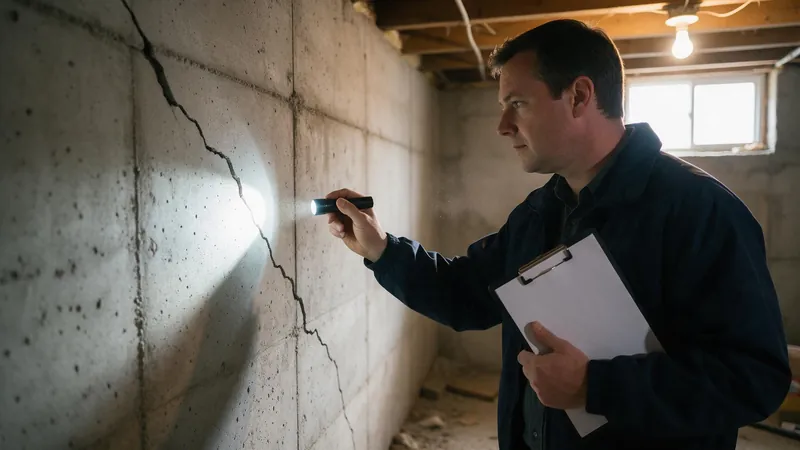
The jobs
01A crack in a slab or a wall
Fine map cracking in the surface layer is common. A straight crack with rust staining can sit over a bar. A first look can show steel or a void under the line.
02Core and test locations
A core for a strength test, or the spot for another test, should miss the bars. Find them first, then mark the spot with room to move.
03A garage slab that may be post-tensioned
Under a house or a parking deck, a PT slab is a referral, not a test: nothing gets drilled to find out.
Try the job in 3D
A post-tensioned slab. The deeper spots are PT ducts: on an inspection, something to record and refer, not to drill.
One situation from the Scan lab, which has all eleven.
How pros do it
- Know what your standard asks for. ASHI's standard asks the inspector to inspect structural components, including the foundation and framing, but does not require engineering or architectural services or analysis1. It calls its inspections not technically exhaustive1.
- Extra tools need competence. Texas requires reasonable and appropriate tools, but lists thermal imaging and moisture meters as specialized equipment an inspection does not require. To go beyond the standard, "the inspector must possess the competency required to do so"2.
- Look first, then find the bars. The IAEA calls visual inspection an essential precursor to any non-destructive test3. Cover meters locate bars before tests that should avoid reinforcement, such as taking cores3.
- Measured cover needs a calibrated method. For the magnetometer (cover meter), the FHWA notes that a cover estimate is only accurate when the spacing of parallel bars is 1.5 times greater than the concrete cover4. Screening Eagle writes that many cover meters and GPR scanners can at best deliver +/- 5 mm accuracy5.
From the trade sources listed below, opened 17 November 2026. They describe professional practice in general, not Eagle XR.
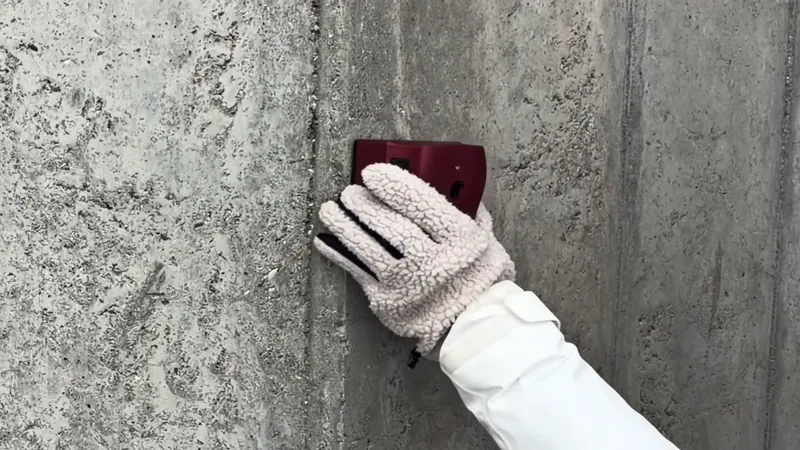
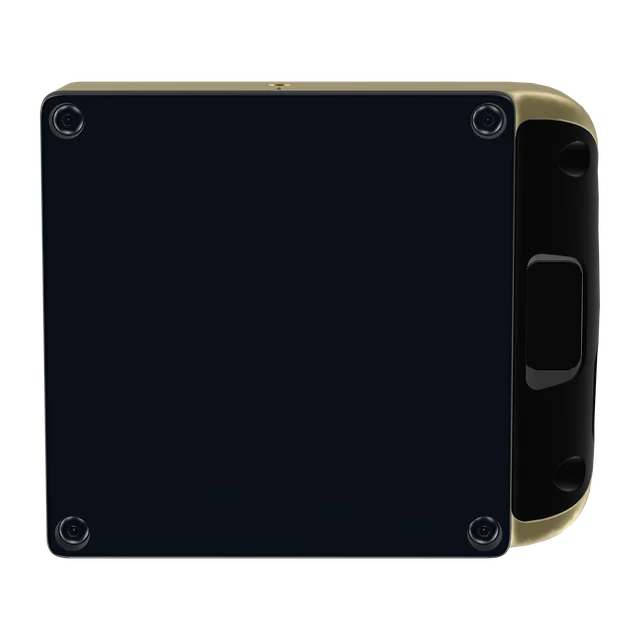
This side goes flat on the surface.
Where Eagle XR fits
- Screening Eagle positions it as the quick look between Profometer for precision cover and Proceq GPR for deep structural investigation6.
- It lists rebar ("every bar, every layer"), PT ducts, voids and cavities, water pipes and cables, and the back wall7, to a stated depth of up to 40 cm in concrete8. The listing names concrete, drywall and masonry7; the product page says Eagle Intelligence is trained on concrete and learning more materials8.
- It scans one line at a time, in one direction: slide it forward along the line, lift it, and start the next. A few lines across a crack or a test spot are a quick check.
- Scans are saved, synced and shareable8, and the listing describes taking a screenshot, marking it up on your phone and sending it to the team7.
Where it does not
- Eagle XR is not a GPR: Screening Eagle calls it a first look for everyday work, to see whether a spot is clear or whether to call an expert. For investigations, mapping and reports, it points professionals to GPR systems8.
- Depth accuracy, bar size and a formal report format are not published. A cover survey with measured values stays with a calibrated cover meter or GPR, a trained operator and a written report.
- Inspectors and surveyors are not on Screening Eagle's Built for list; engineers, architects and facility managers are8. Check your standard, your agreement and your insurance before you offer scanning.
Questions inspectors and surveyors ask
Does a home inspection standard require a concrete scanner?General
No, not under ASHI's standard or the Texas rules. ASHI's standard covers "readily accessible, visually observable, installed systems and components"1. A scanner is an extra service. More in our guide to home inspector tools.
Can it do a concrete cover survey?Not published
Not to a stated accuracy. Our guide to concrete cover surveys explains what one takes.
Can I use it to pick a spot for a core or a test?General
As a first look, yes: bars, PT ducts, pipes and cables are what a core should miss. Your procedure and the engineer decide who approves a core location, not the scanner.
Can I put the scan in my inspection report?Product page, App Store listing
As a picture, yes, but a formal report format has not been published. Label the screenshot as a first look, and say that depth accuracy and bar size are not published either.
Can it tell me why a slab cracked?General
No: a scan alone cannot, and the cause is often a question for an engineer. ASHI's standard does not require the inspector to offer an opinion about the adequacy of structural systems and components1.
The garage slab may be post-tensioned. What then?General
Note it, photograph it and refer it to the engineer. Read drilling into a post-tensioned slab.
Is a scan part of a RICS Level 3 survey?General
Not as standard. RICS describes Level 3 equipment as a damp meter, binoculars and torch, plus a ladder, and says the surveyor does not force or open up the fabric of the building without occupier or owner consent9. Agree any extra, such as a scan, with the client in advance.
Does it replace a testing firm or a structural engineer?Product page
No. Screening Eagle says Eagle XR "gives every crew a first look into concrete, so the experts can focus on the high-value jobs"8.
Anything else: search every answer on this site on Before you buy, or ask Screening Eagle directly.
Ready for your own job?
CHF 3,950per scanner, excluding VAT, import taxes and delivery. Ordering happens on Screening Eagle's shop.
Buy in Solar GoldPartner link: we may earn a commission. You pay Screening Eagle's normal price.
- Sold and shipped by Screening Eagle
- Same price in all four finishes
- Card, Apple Pay or Google Pay
- Express shipping from Switzerland. US orders ship from Pennsylvania
Sources
- American Society of Home Inspectors, ASHI Standard of Practice for Home Inspections, effective 1 March 2014, read 17 November 2026, homeinspector.org
- Texas Real Estate Commission, Standards of Practice, 22 TAC 535.227 to 535.233, online version, read 17 November 2026, trec.texas.gov
- IAEA, Guidebook on non-destructive testing of concrete structures, Training Course Series No. 17 (2002), sections 1 and 9, read 17 November 2026, www-pub.iaea.org
- US Federal Highway Administration, InfoTechnology, Bridge: Magnetometer (MM), read 17 November 2026, infotechnology.fhwa.dot.gov
- Screening Eagle Tech Hub, application note: Measure 1st Layer Rebar Cover with Maximum Precision, read 17 November 2026, screeningeagle.com
- Screening Eagle, Eagle XR launch press release, 17 September 2026, read 17 November 2026, screeningeagle.com
- Apple App Store, Eagle XR listing by Screening Eagle Technologies AG, read 15 November 2026, apps.apple.com
- Screening Eagle, Eagle XR product page and FAQ, read 15 November 2026, xr.screeningeagle.com
- RICS, Description of the RICS Home Survey Level 3, read 17 November 2026, rics.org