Home / Jobs / Core drilling and concrete cutting
Jobs for core drillers and concrete cutters
Concrete scanning for core drilling and cutting contractors
Cores for every trade, wall saw openings, flat-saw trenches. You are the last one to look before the hole. The question is which look each job needs.
Before you core or cut concrete
Stop and call the engineer and a GPR professional if
- you find PT: on PT, nothing is cored without approval
- the GC needs a marked-clear survey or a report
The short version of this page. The details and sources follow below.
From Concrete scanning for core drilling and cutting contractors: drillclear.com/jobs/core-drilling-and-cutting, where every step has its sources.
- US
- core, wall saw, flat saw, slab scan, marked clear, PT
- UK
- diamond drilling, wall sawing, floor sawing, soffit, PT tendons
The jobs
01A doorway through a wall
Scan face A, then face B before anything goes through. Compare the marks: an object near face B can show only from that side.
02A core through an elevated slab
A grid around the core, every mark joined into lines, and a clear window bigger than the bit.
03A trench on grade
One face, conduits near the bottom of the slab, and a cut that goes full depth.
Try the job in 3D
A 250 mm wall with a doorway marked on face A. Scan, then turn the wall.
One situation from the Scan lab, which has all eleven.
How pros do it
- Bit length from the thickness. Hilti counts working out the bit length from the measured slab or wall thickness as part of the detection job1.
- Two directions, every location. Experienced operators always scan in at least two directions at right angles at each location2.
- Know what one face can cut. One cutting contractor says a 14-inch blade on a cut-off saw cuts only 5-1/2 inches, and that crews score both sides of a wall3.
- Moved the core? Scan again. A scan of the old spot does not automatically clear the new one4.
- Dense steel. Where rebar is everywhere, one crew learned to focus on the weakest signals to find the gaps in the rebar5.
- PT is red. Mark tendons in red with a PT notation6; on PT, nothing is cored without approval.
From the trade sources listed below, opened 16 November 2026. They describe professional practice in general, mostly with GPR, not Eagle XR.
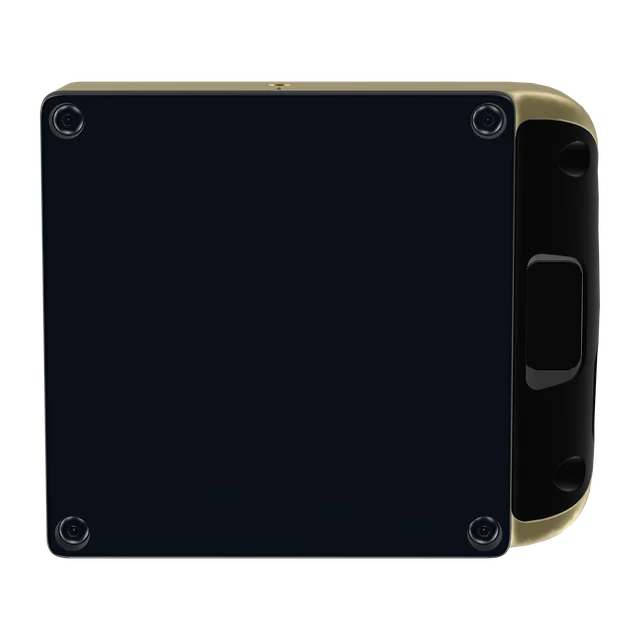
This side goes flat on the surface.
Where Eagle XR fits
- Screening Eagle says to use it before every hole, core or cut in concrete walls, slabs and columns7, and places it between Profometer for precision cover and Proceq GPR for deep structural investigation8.
- Rebar, PT ducts, conduits, plastic pipes, voids and the back wall9, to a stated 40 cm in concrete7.
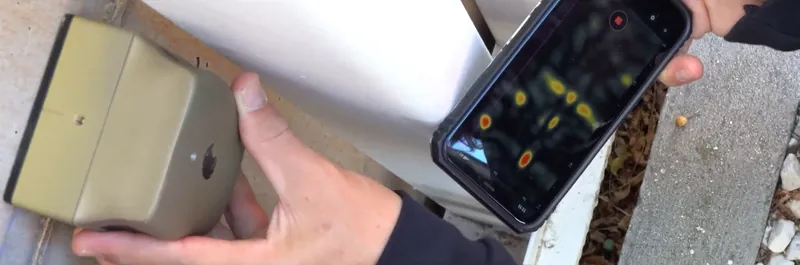
- It scans one line at a time, in one direction: slide it forward along the line, lift it, start the next. A crew member can take a first look at each location while the rig is set up.
Where it does not
- Not a GPR: a first look for everyday work, to see whether a spot is clear or whether to call an expert; for investigations, mapping and reports, Screening Eagle points professionals to GPR systems7.
- Depth accuracy and minimum spacing between objects are not published.
Questions core drillers and concrete cutters ask
Can it give me the slab thickness for the bit?Product page, general
It shows where the slab ends, but how accurate that is has not been published. Where the thickness decides the job, check it against a known reference point4.
Can I hand the GC a report or a marked-clear layout?Product page
No report format has been published for Eagle XR, so a marked-clear survey stays a GPR job. Scans are saved, synced and shareable7.
Does it work in heavily reinforced walls?App Store listing, general
Screening Eagle says it shows every bar in every layer, but with radar in general the top layer can hide deeper objects. The claim is in the App Store listing9, the caution from Penhall10.
Should I scan both faces of a wall?General
Yes, for an opening, wherever you can reach both faces: each face shows what is near it best, and you may cut from both.
I already own a GPR. Why carry this too?Product page
For a quick first look at each location, keeping the GPR for surveys, PT and reports.
Who is liable if a core still hits something?Not published
Not published, and not a scanner question. It depends on your contract, the site procedure, the law that applies and your insurance.
Anything else: search every answer on this site on Before you buy, or ask Screening Eagle directly.
Ready for your own job?
CHF 3,950per scanner, excluding VAT, import taxes and delivery. Ordering happens on Screening Eagle's shop.
Buy in Solar GoldPartner link: we may earn a commission. You pay Screening Eagle's normal price.
- Sold and shipped by Screening Eagle
- Same price in all four finishes
- Card, Apple Pay or Google Pay
- Express shipping from Switzerland. US orders ship from Pennsylvania
Sources
- Hilti New Zealand, Typical Applications for Detection Systems, read 16 November 2026, hilti.co.nz
- SPH Engineering, GPR Scanning in Concrete to Find Rebar, PT Cables and Voids, read 16 November 2026, sphengineering.com
- Journal of Light Construction, Cutting Concrete: How a Pro Breaks Through, read 16 November 2026, jlconline.com
- Associated Builders and Contractors, Central Texas chapter, GPR Concrete Scanning Before the Core Drill Starts, read 16 November 2026, abccentraltexas.org
- Walls & Ceilings, Scanning for Rebar in Concrete When It's 'Everywhere' (an article about Zircon's scanner, 2023), read 16 November 2026, wconline.com
- Penhall, Post-Tension vs Rebar: How to Tell What You're Dealing With Before You Drill, read 16 November 2026, penhall.com
- Screening Eagle, Eagle XR product page and FAQ, read 15 November 2026, xr.screeningeagle.com
- Screening Eagle, Eagle XR launch press release, 17 September 2026, screeningeagle.com
- Apple App Store, Eagle XR listing by Screening Eagle Technologies AG, read 15 November 2026, apps.apple.com
- Penhall, Slab Scanning 101: When You Need It and What it Includes, read 16 November 2026, penhall.com