Home / Jobs / Engineers and architects
Jobs for engineers and architects
Concrete scanning for engineers and architects
A contractor wants to core next to a column. A 1960s building has no drawings. A wall has to be opened for a doorway. Before you specify a survey, you want to know whether there is steel, roughly where, and how thick the element is.
Before you approve a penetration
Stop and call a GPR professional for a full survey if
- deep spots change depth along their length, which can mean tendons
- you need depth accuracy or a report
- the lower mat matters and the upper mat hides it
The short version of this page. The details and sources follow below.
From Concrete scanning for engineers and architects: drillclear.com/jobs/engineers-and-architects, where every step has its sources.
- US
- engineer of record, as-builts, cover, top and bottom mat, CMU
- UK
- structural engineer, cover meter, as-built survey, soffit
The jobs
01How thick is it?
The back of the element on the picture gives the thickness.
02Approving a penetration
A first look at the requested spot, sent by the contractor, before you decide whether it needs a full survey.
03A PT slab
Deep spots that change depth along their length can be tendons: stop, and survey properly.
Try the job in 3D
A wall of unknown thickness. The straight line on the picture is the back of the wall.
One situation from the Scan lab, which has all eleven.
How pros do it
- Lines across the top bars. The FHWA says GPR survey lines should run perpendicular to the direction of the top reinforcement1.
- Calibrate depth. Calibrate with cores or drill holes from the surface to the top of a selected bar, which the FHWA calls desirable1.
- Expect the lower mat to be harder. The lower half of a deck can be difficult because of the rebar mat in the upper half1.
- Bar size needs another tool. GPR cannot reliably determine bar diameter2. Cover meters estimate it: Hilti's PS 300 is built to estimate rebar size and the depth of concrete cover3.
From the trade sources listed below, opened 16 November 2026. They describe professional practice in general, mostly with GPR, not Eagle XR.
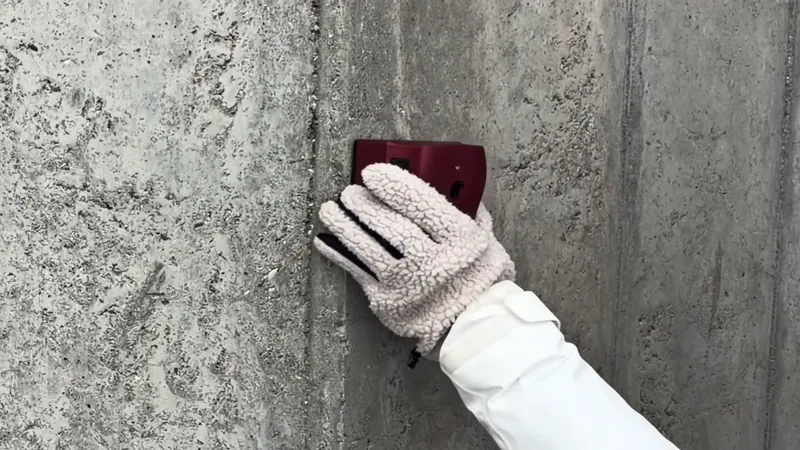
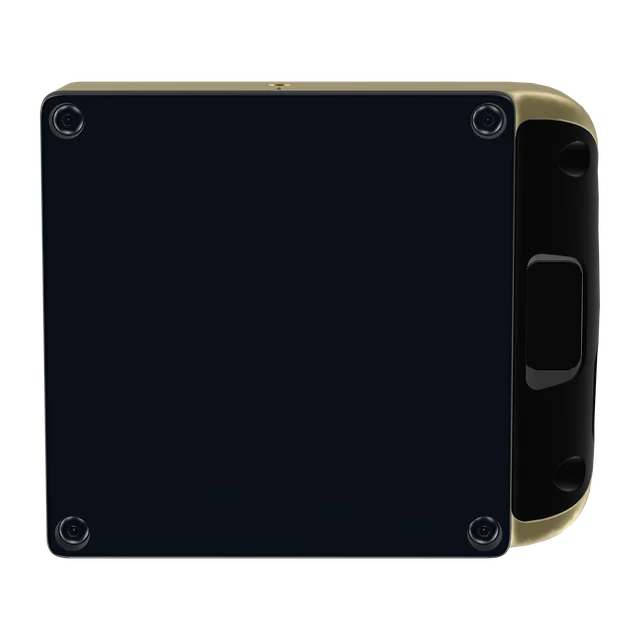
This side goes flat on the surface.
Where Eagle XR fits
- Screening Eagle lists engineers and architects among its users, for when engineers simply need to understand what's inside4.
- Positioned as the quick look between Profometer for precision cover and Proceq GPR for deep structural investigation5.
- Rebar, PT ducts, voids and cavities, pipes, conduits and the back wall6, up to 40 cm in concrete4.
- Scans are saved, synced and shareable4, and you can screenshot one, mark it up and send it to the team6.
Where it does not
- Minimum spacing between objects is not published.
- Not a GPR: a first look for everyday work, to see whether a spot is clear or whether to call an expert; for investigations, mapping and reports, Screening Eagle points professionals to GPR systems4.
Questions engineers and architects ask
How accurate are depth and position?Not published
Not published. Screening Eagle states the 40 cm depth range4 but no tolerance. Ask Screening Eagle before you order if it decides the job for you.
Can it give me bar size and spacing?Not published, general
Spacing you can read from the marks of several lines; bar size has not been published. For bar size, see the last step under How pros do it.
Can I get the data, not just a screenshot?Product page, not published
Export formats have not been published, only that scans are saved, synced and shareable.
Does it show voids?App Store listing, product page
Yes, voids are listed. The product page mentions even air voids4.
Does it work on masonry?App Store listing, product page
Masonry is listed, but Screening Eagle says its intelligence is trained on concrete and still learning more materials. Brick and block and drywall are on the App Store list next to concrete (dry, normal or wet)6; the training note is on the product page4.
Anything else: search every answer on this site on Before you buy, or ask Screening Eagle directly.
Ready for your own job?
CHF 3,950per scanner, excluding VAT, import taxes and delivery. Ordering happens on Screening Eagle's shop.
Buy in Solar GoldPartner link: we may earn a commission. You pay Screening Eagle's normal price.
- Sold and shipped by Screening Eagle
- Same price in all four finishes
- Card, Apple Pay or Google Pay
- Express shipping from Switzerland. US orders ship from Pennsylvania
Sources
- US Federal Highway Administration, InfoTechnology, Bridge: GPR (Locating Reinforcement), read 16 November 2026, infotechnology.fhwa.dot.gov
- SPH Engineering, GPR Scanning in Concrete to Find Rebar, PT Cables and Voids, read 16 November 2026, sphengineering.com
- Hilti New Zealand, How to choose the right detection tool, read 16 November 2026, hilti.co.nz
- Screening Eagle, Eagle XR product page and FAQ, read 15 November 2026, xr.screeningeagle.com
- Screening Eagle, Eagle XR launch press release, 17 September 2026, screeningeagle.com
- Apple App Store, Eagle XR listing by Screening Eagle Technologies AG, read 15 November 2026, apps.apple.com