Home / Jobs / EV charger installers
Jobs for EV charger installers
Concrete scanning for EV charger installers
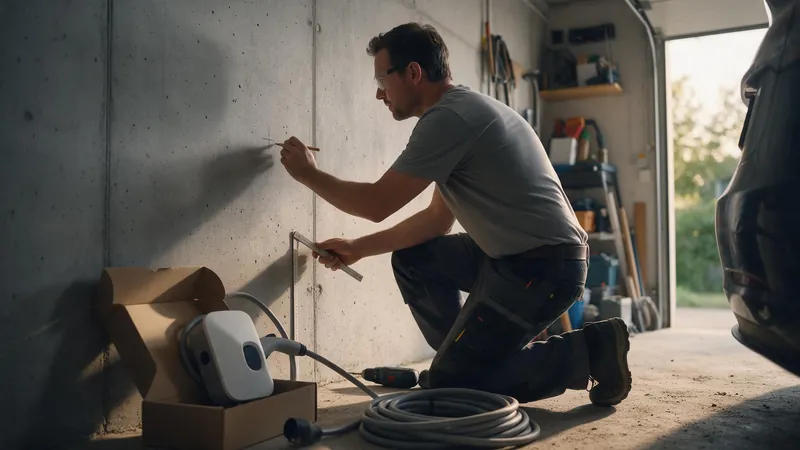
A wallbox on a home garage wall. A row of Level 2 chargers in a condo parking garage, with conduit along the ceiling below and a core up to each station. Most of it is ordinary drilling. The exception is the parking structure: many are post-tensioned.
Before you drill for an EV charger
Stop and call the engineer and a scanning professional if
- the deck is post-tensioned, or nobody can say whether it is
- a pedestal anchor or core sits next to a column, or the route crosses a beam
- you need a fixing depth into the ceiling of a post-tensioned deck
- the condo board or an insurer wants a documented scan
The short version of this page. The details and sources follow below.
From Concrete scanning for EV charger installers: drillclear.com/jobs/ev-charger-installers, where every step has its sources.
- US
- Level 2 charger, EVSE, wall connector, pedestal, parking deck, PT cables, x-ray the slab
- UK
- wallbox, chargepoint, car park, rear cable entry, SWA, core through the slab
The jobs
01A wallbox in a home garage
Two or three fixings and a cable entry through the wall. Scan each fixing point and the cable route with lines across and at 90 degrees.
02Chargers in a condo or parking garage
Pedestal anchors and cores go into a deck that may be post-tensioned. Find out first, and check the tendon layout before you drill.
03Conduit on the ceiling below
Hangers and straps go up into the soffit of the deck. How deep they may go is the engineer's call.
Try the job in 3D
A 250 mm post-tensioned slab. Scan one line, then rotate 90 degrees: the deeper spots are PT ducts. For a charger pedestal or a conduit core, that picture goes to the engineer before anyone drills.
One situation from the Scan lab, which has all eleven.
How pros do it
- Find out whether the deck is post-tensioned. PT is common in parking garages, high-rise residential buildings, offices and hospitals1. A condo engineers' guide gives clues: PT slabs can be as thin as about 150 mm, and some garages show visible joints around the slab perimeter2. In houses, many PT slabs are stamped3. If you cannot confirm it, a scanning contractor treats the slab as post-tensioned until a scan shows otherwise1. With a first-look tool, let the drawings or the engineer settle it.
- Know where the tendons sit. Tendons sit high over supports and low at midspan, and banded tendons run in tight groups along column lines1. In a typical layout, that puts them near a pedestal anchor beside a column and near a conduit strap at midspan: check the slab you are on. For anchors into a PT soffit, Hilti says you need to know the distance from the surface to the strands4.
- Plan the route before the core. A FacilitiesNet article on garage retrofits warns that coring through the tension cables of a cast-in-place PT slab can damage the strands and the integrity of the structure5. An engineer on Mike Holt's forum would not penetrate the beams without a structural engineer's approval6.
- Scan, with an engineer in charge. For PT condos, the guide says the board should require an x-ray or GPR scan before any significant drilling or coring, overseen by an experienced engineer2. An electrician on the forum has had x-rays done before drilling or cutting in parking decks and post-tensioned buildings6.
From the trade sources listed below, opened 17 November 2026. They describe professional practice in general, not Eagle XR.
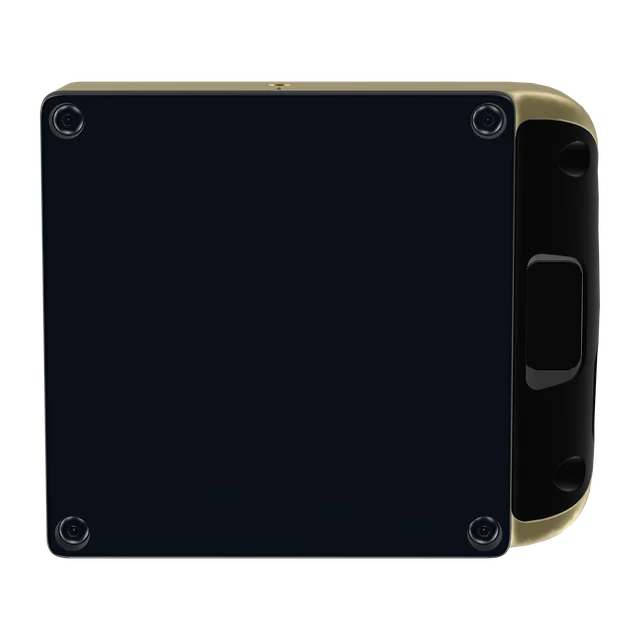
This side goes flat on the surface.
Where Eagle XR fits
- For use before every hole, core or cut in concrete walls, slabs and columns7.
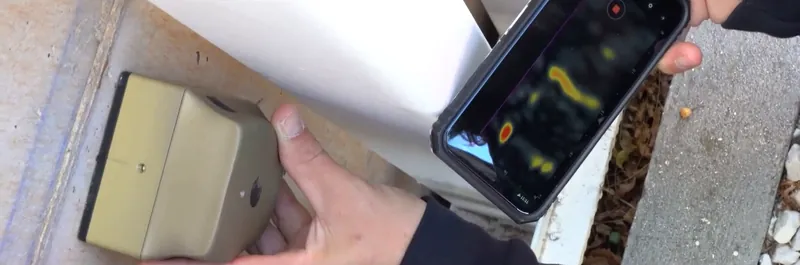
- It lists PT ducts (which carry post-tension tendons), electric cables and conduits, and rebar, each in colour at its depth8. Materials: concrete (dry, normal or wet), drywall, and masonry (brick and block) in the App Store listing8; the product page says Eagle Intelligence is trained on concrete and learning more materials7.
- It scans one line at a time, in one direction: you slide it forward along the line, lift it, and start the next line.
- Scans are saved, synced and shareable7, and the listing describes taking a screenshot, marking it up on your phone and sending it to the team8.
Where it does not
- On a post-tensioned deck, the engineer decides, whatever any scanner shows.
- Eagle XR is not a GPR: Screening Eagle calls it a first look for everyday work, to see whether a spot is clear or whether to call an expert. For investigations, mapping and reports, it points professionals to GPR systems7, including a documented scan for a condo board or an insurer.
- Screening Eagle has not published whether it tells you a cable is live. Treat every cable as live: isolate and prove dead before you drill near one.
- Screening Eagle has not addressed what lies in the ground under a slab on grade, such as a trench out to a driveway charger.
Questions EV charger installers ask
Is it better to install an EV charger inside or outside my garage?Manufacturer manuals
Both work: the manuals we read allow either. The zappi is rated for indoor or outdoor permanent mounting9, and Tesla gives a minimum height of 18 in (0.45 m) indoors and 24 in (0.6 m) outdoors10. Tesla also advises against putting the Wall Connector on the other side of concrete, masonry or metal studs from your Wi-Fi10, so a charger outside a concrete garage wall may lose the signal.
At what height does a wall charger go?Tesla manual
It depends on the charger, so use its manual. For its Gen 3 Wall Connector, Tesla gives a maximum of 60 in (1.52 m), a recommended ~45 in (~1.15 m), and the minimums above, on any flat, vertical surface that can carry its weight of about 10 lb (4.5 kg)10.
Can I anchor a charger pedestal into a parking garage floor?General
Not until you know whether the deck is post-tensioned, and on a PT deck not without the engineer. The condo guide calls it crucial not to drill or core a post-tensioned slab without precise knowledge of where the cables are2.
My home garage floor is stamped post-tensioned. Can I bolt to it?General
Ask the builder or an engineer first. The Concrete Network advises against cutting or drilling post-tensioned slabs, because a cut tendon is very difficult to repair, and notes that tendons at 48 inches on center are common in residential construction3. A wall-mounted charger avoids the floor.
How deep can conduit fixings go into a post-tensioned ceiling?General, not published
That number comes from the engineer. The condo guide says some nominal drilling may be permitted, but a structural engineer must define the maximum depth that can be drilled without risking damage to the cables2. Eagle XR's depth accuracy is not published.
Why does charging in a condo garage cost so much more than at a house?General
A condo retrofit can mean more drilling and longer cable runs than a house. CBC reports, in Canada, about $1,500 for a Level 2 charger in a single-family home, and one condo board was quoted $50,000 for 10 cars11. The structure changes the ease and cost too: wood frame, block and plank, cast in place or post-tensioned12. In the condo guide's experience, x-rays require evacuating multiple floors2.
Should our crew buy a scanner or hire scans?General, product page
It depends how often you drill. One electrician on Mike Holt's forum found hiring a scanning company considerably cheaper than buying a scanner6. Eagle XR is CHF 3,950, EUR 4,190, USD 4,830 or GBP 3,590, excluding VAT, import taxes and delivery7, with US sales tax added where it applies13.
Anything else: search every answer on this site on Before you buy, or ask Screening Eagle directly.
Ready for your own job?
CHF 3,950per scanner, excluding VAT, import taxes and delivery. Ordering happens on Screening Eagle's shop.
Buy in Solar GoldPartner link: we may earn a commission. You pay Screening Eagle's normal price.
- Sold and shipped by Screening Eagle
- Same price in all four finishes
- Card, Apple Pay or Google Pay
- Express shipping from Switzerland. US orders ship from Pennsylvania
Sources
- Trinity Subsurface, Scanning Post-Tension Slabs Before You Core or Cut, read 16 November 2026, trinitysubsurface.com
- Canadian Condominium Institute, Toronto and Area Chapter, Post-Tensioning (Maintenance and Repairs), 2024, read 17 November 2026, cci.ca
- Concrete Network, Post-Tension Basics: How Post-Tensioned Slabs Are Built, read 17 November 2026, concretenetwork.com
- Hilti USA Engineering Center, Expansion anchors into underside of (E) PT slab, read 16 November 2026, hilti.com
- FacilitiesNet, How Parking Owners Can Prepare for Electric Vehicles (2021), read 17 November 2026, facilitiesnet.com
- Mike Holt's Forum, thread "Parking Deck Ceiling Conduit" (2022), read 17 November 2026, forums.mikeholt.com
- Screening Eagle, Eagle XR product page and FAQ, read 15 November 2026, xr.screeningeagle.com
- Apple App Store, Eagle XR listing by Screening Eagle Technologies AG, read 15 November 2026, apps.apple.com
- myenergi, zappi v2.1 Installation and Operation Manual, Rev 2.1.5, June 2022, read 17 November 2026, myenergi.com
- Tesla, Gen 3 Wall Connector Manual, 48A Single Phase (North America), read 17 November 2026, digitalassets.tesla.com
- CBC News, How these condo dwellers got EV charging in their buildings, 25 June 2025, read 17 November 2026, cbc.ca
- WGI, EV Infrastructure: What Do You Need? (2022), read 17 November 2026, wginc.com
- Screening Eagle, official Eagle XR shop and return policy, read 14 November 2026, store.screeningeagle.com