Home / Jobs / Security and smart home installers
Jobs for security and smart home installers
CCTV and alarm installation in concrete
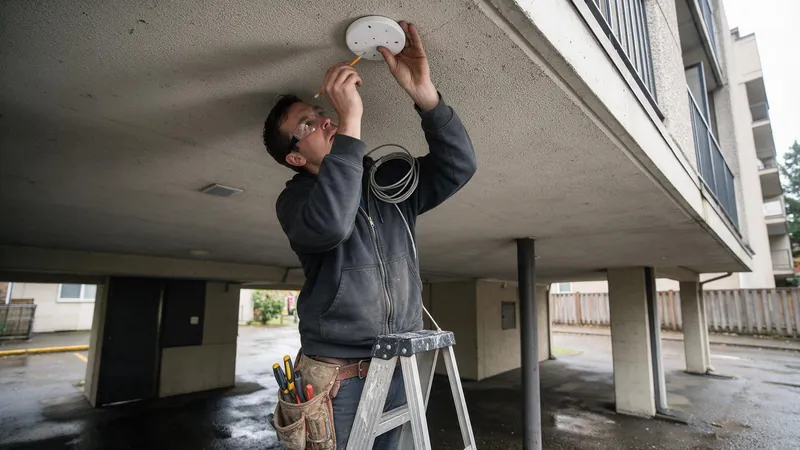
A camera on the corner of a block wall, a cable entry hole through an outside wall, a keypad beside the front door, a dome on a car park ceiling. The work is many small holes in buildings you did not build, and the cable hole often wants to go where the electrical service already is.
Before you drill for a camera or alarm
Stop and call the engineer, the owner or the managing agent if
- a car park deck or ceiling may be post-tensioned
- an older building has no asbestos information
- drilling is not allowed and there is no existing cable route
The short version of this page. The details and sources follow below.
From CCTV and alarm installation in concrete: drillclear.com/jobs/security-and-smart-home-installers, where every step has its sources.
- US
- low voltage, CCTV, NVR, PoE, access control, maglock, service entrance
- UK
- CCTV, intruder alarm, door entry, cable entry, PIR, NSI, SSAIB
The jobs
01The cable entry hole
The hole from the camera to the inside goes through the whole wall, sometimes beside the electrical service. Check both faces and the wall thickness before you pick the bit.
02A door entry panel or keypad
Beside a door, several cables can run past the panel. Scan lines across the panel area, then at 90 degrees to them.
03Cameras on a car park ceiling
Car park decks can be post-tensioned. Nothing goes into that soffit until the engineer says so.
Try the job in 3D
The soffit of a post-tensioned slab seen from below. The lab labels the three planned holes for a sprinkler main and draws each one to its depth: green when clear, red when it reaches something. Read them as camera and cable tray fixings.
One situation from the Scan lab, which has all eleven.
How pros do it
- Measure inside and outside before you drill through. Ontario's Electrical Safety Authority saw an alarming trend of communication installers drilling into, or touching, electrical wiring while drilling through building walls1. It asks installers to measure inside and outside the structure before drilling holes1.
- Keep clear of the service entrance. Many communication installations sit close to electrical service equipment, so drilling into a service cable can ignite a structure fire1. The root cause the regulator gives for every case: "failure to ensure the area is clear and safe for drilling"1.
- Check the wall, then follow the maker. Hikvision asks for a wall strong enough for at least 4 times the weight of the device and the mount2. Ring has masonry pilot holes drilled with a 1/4 inch bit for the included anchors3. Reolink says to check for electrical wiring, plumbing, gas lines, HVAC ducts and structural components before drilling4.
- In older buildings, think asbestos too. The UK Health and Safety Executive lists fire and burglar alarm installers and computer and data installers among the workers liable to disturb asbestos in their normal work, who need asbestos training5.
From the trade sources listed below, opened 17 November 2026. They describe professional practice in general, not Eagle XR.
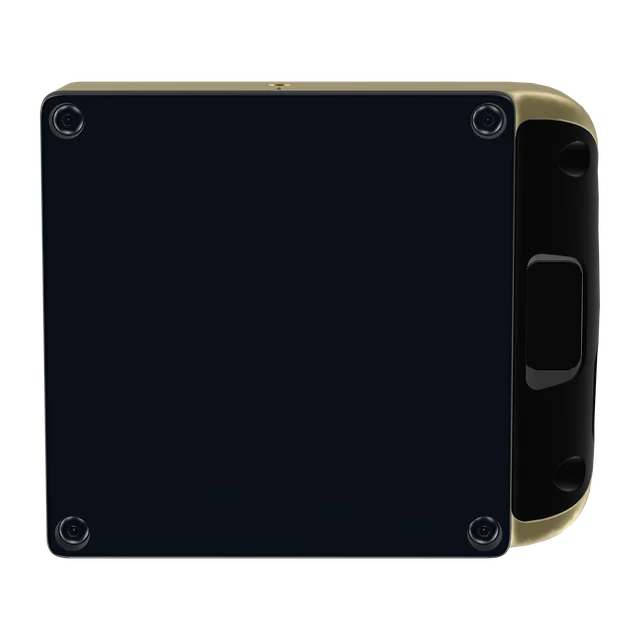
This side goes flat on the surface.
Where Eagle XR fits
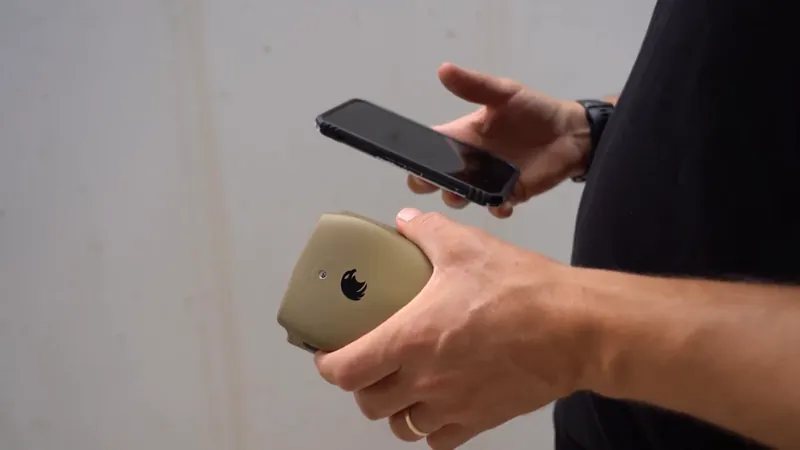
- It lists electric cables and conduits, plastic water pipes, rebar and PT ducts, each in colour at its depth6.
- Walls, slabs, columns and corners7; at 100 x 90 mm it is made to fit in tight corners7. Materials: concrete (dry, normal or wet), drywall, and masonry (brick and block) in the App Store listing6; the product page says Eagle Intelligence is trained on concrete and learning more materials7.
- One sweep across a wall, ceiling or floor8, with a 750 g sensor7: overhead work included.
- It shows the back of the element7.
Where it does not
- Whether it tells a live cable from a dead one has not been published. Treat every cable as live, the service cable most of all.
- Render and cladding are not addressed in Screening Eagle's published facts.
- A scan does not show asbestos.
- Eagle XR is not a GPR: Screening Eagle calls it a first look for everyday work, to see whether a spot is clear or whether to call an expert. For investigations, mapping and reports, it points professionals to GPR systems7.
Questions security and smart home installers ask
Drilling a hole for a CCTV camera: what should I check first?General
Check what is behind the bracket, what is behind the cable hole, and whether the wall takes the load. A scan gives a first look at the first two; the wall, the fixing and the makers' data in How pros do it decide the third.
How do you install CCTV without drilling?Manufacturer
Mostly with battery or solar cameras. Reolink suggests one for rental properties where drilling through exterior walls is off-limits4. A wired system with power over the network cable usually needs a cable route into the building: an existing one, or a new hole. Where drilling is not allowed, that is a question for the owner or the managing agent, not for a scanner.
CCTV installation tips for concrete and block walls?Regulations
Use the maker's template and fixings, check for services, then scan the bracket spot and the cable route. For a doorbell or keypad, expect cables to the bell push, the light switch and the socket: in the UK, cables less than 50 mm deep may run "either horizontally or vertically, to the point accessory or switchgear"9, and older wiring may not follow the zones.
We fit cameras in a car park. Anything special?General
Yes: find out whether the deck is post-tensioned before anything goes into the soffit. Anchor pockets and PT end caps confirm PT construction10, and a scanning contractor's rule is to treat the slab as post-tensioned until a scan shows otherwise11. With a first-look tool, let the drawings or the engineer settle it.
Does it see through a cavity wall to the outer leaf?Not published
Not published. Ask Screening Eagle before you order if your job depends on it. It states a depth of up to 40 cm in concrete7, but how it reads two leaves with a cavity and insulation between them has not been published.
Does a scan show asbestos?General
No, and Screening Eagle makes no such claim. In an older building, ask for the asbestos information before you drill.
Can I keep a record of what I scanned for the customer?Product page, App Store listing
Yes, as a screenshot; a formal report format is not published. Scans are saved, synced and shareable7, and the listing describes taking a screenshot, marking it up on your phone and sending it to the team6: the picture goes into the job file and to the site manager.
Anything else: search every answer on this site on Before you buy, or ask Screening Eagle directly.
Ready for your own job?
CHF 3,950per scanner, excluding VAT, import taxes and delivery. Ordering happens on Screening Eagle's shop.
Buy in Solar GoldPartner link: we may earn a commission. You pay Screening Eagle's normal price.
- Sold and shipped by Screening Eagle
- Same price in all four finishes
- Card, Apple Pay or Google Pay
- Express shipping from Switzerland. US orders ship from Pennsylvania
Sources
- Electrical Safety Authority (Ontario), Flash 22-23-FL, Installation of communication wiring around electrical equipment (May 2022), read 17 November 2026, esasafe.com
- Hikvision, Dome Network Camera Quick Start Guide (2019), hosted by distributor Mayflex, read 17 November 2026, media.mayflex.com
- Ring, Installing battery-powered doorbells (support article), read 17 November 2026, ring.com
- Reolink blog, How to Wire Security Camera Outdoors and Indoors (September 2026), read 17 November 2026, reolink.com
- Health and Safety Executive (UK), Asbestos information, instruction and training, read 17 November 2026, hse.gov.uk
- Apple App Store, Eagle XR listing by Screening Eagle Technologies AG, read 15 November 2026, apps.apple.com
- Screening Eagle, Eagle XR product page and FAQ, read 15 November 2026, xr.screeningeagle.com
- Screening Eagle, Eagle XR launch press release, 17 September 2026, screeningeagle.com
- Professional Electrician, What is a Cable Safe Zone? (23 October 2018), read 17 November 2026, professional-electrician.com
- Penhall, Post-Tension vs Rebar: How to Tell What You're Dealing With Before You Drill, read 16 November 2026, penhall.com
- Trinity Subsurface, Scanning Post-Tension Slabs Before You Core or Cut, read 16 November 2026, trinitysubsurface.com