Home / Jobs / Sprinkler fitters and HVAC installers
Jobs for sprinkler fitters and HVAC installers
Concrete scanning for sprinkler and HVAC hangers
Hangers for the sprinkler main, trapezes for ductwork, anchors into the soffit from a lift. Most of the job is overhead. On a post-tensioned floor the tendons usually sit lowest, closest to you, at midspan, so an anchor that clears the bars in plan can still reach a tendon in depth.
Before you anchor hangers into a soffit
Stop and call the engineer if
- an anchor would come close to a tendon
- you see something you cannot place on a PT slab
- the concrete sits on a metal deck
The short version of this page. The details and sources follow below.
From Concrete scanning for sprinkler and HVAC hangers: drillclear.com/jobs/sprinkler-and-hvac, where every step has its sources.
- US
- hangers, trapeze, all-thread, drop-in anchor, PT cables, deck
- UK
- soffit, drop rods, fixings, PT tendons, slab underside
The jobs
01Hanger anchors in a PT soffit
Three anchors on one line: one under a conduit that lies deeper than the hole, one next to a tendon that lies within its reach.
02A duct riser through the floor
A bigger core needs a bigger clear window: scan a grid around it and keep room to move.
03A parking garage deck
Patched anchor pockets on the slab edge point to PT. Stop, scan, and let the engineer approve.
Try the job in 3D
The soffit of a post-tensioned slab, seen from below. The three planned holes are drawn on the picture to their depth: green clear, red when they reach something.
One situation from the Scan lab, which has all eleven.
How pros do it
- Find out whether it is PT. Anchor pockets and PT end caps confirm PT construction, and the structural drawings show the tendon layout1. A scanning contractor's rule is to treat the slab as post-tensioned until a scan shows otherwise2. With a first-look tool, let the drawings or the engineer settle it.
- Know the tendon depth, not just its line. For anchors into the underside of a PT slab, Hilti says it is important to know the distance from the surface to the strands3.
- Keep away, and leave room to move. Hilti says there is no exact value, and that engineers try to embed away from the post-tension cables3. One scanning firm keeps a 3-inch buffer from every tendon2.
- Mark PT in red. Penhall marks PT, typically in red spray paint with a PT notation1, and Trinity writes the depth beside the marks where it matters2.
From the trade sources listed below, opened 16 November 2026. They describe professional practice in general, mostly with GPR, not Eagle XR.
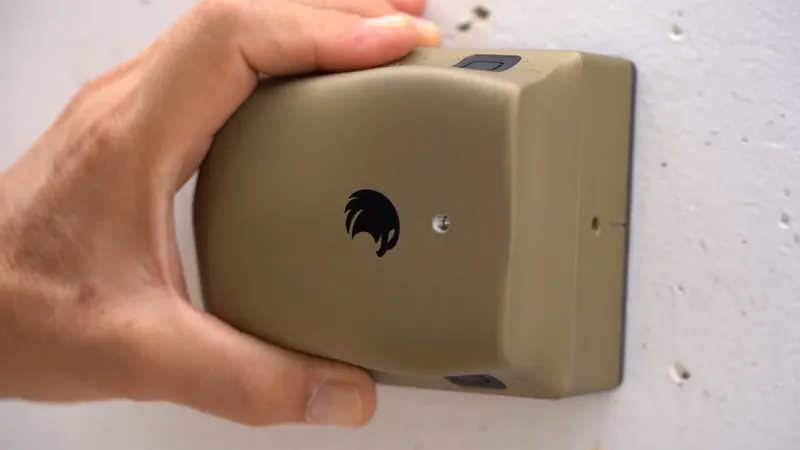
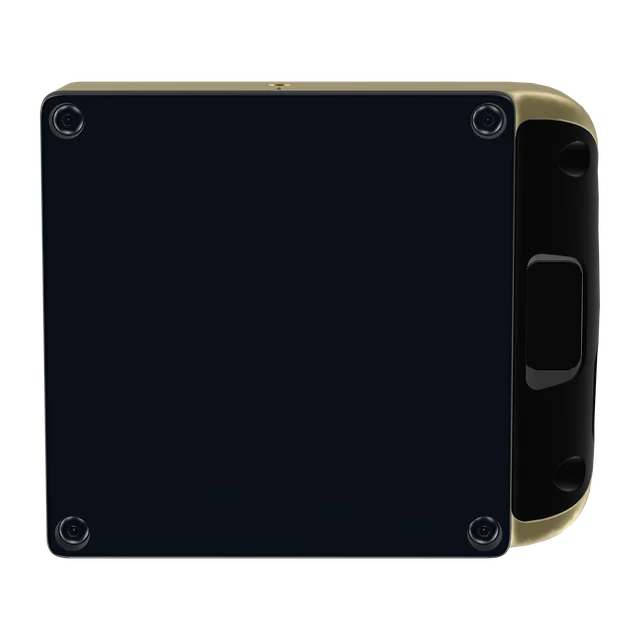
This side goes flat on the surface.
Where Eagle XR fits
- Ceilings are named: one sweep across a wall, ceiling or floor4, with a 750 g sensor5.
- It lists PT ducts (which carry post-tension tendons) next to rebar and conduits, each at its depth6.
- It scans one line at a time, in one direction: slide it forward along the line, lift it, start the next. Scan along the hanger line and across it.
Where it does not
- Not a GPR: a first look for everyday work, to see whether a spot is clear or whether to call an expert; for investigations, mapping and reports, Screening Eagle points professionals to GPR systems5. Let the engineer or the drawings settle whether a slab is PT.
- Concrete on metal deck: not published for Eagle XR, and radar in general does not see through a continuous metal layer7.
Questions sprinkler fitters and HVAC installers ask
Will it show PT tendons, and can it tell them from rebar?App Store listing, general
It lists PT ducts, and telling them from rebar is partly reading the layout. Tendons are usually told apart by their draped profile, changing depth along the span, while rebar stays at a constant depth2. If you see something you cannot place on a PT slab, stop and send the picture to the engineer.
How far from a tendon can I anchor?General
That is the engineer's decision, not a scanner setting. What Hilti and one scanning firm say is under How pros do it.
How accurate is the depth reading?Not published
Not published, and near a tendon millimetres are the engineer's call, not the scanner's. Screening Eagle gives a 40 cm depth range5 but no tolerance; ask Screening Eagle if your work depends on millimetres.
Does it work on concrete over metal deck?Not published, general
Not published for Eagle XR. Follow the deck maker's and the engineer's rules for anchors in the flutes.
Anything else: search every answer on this site on Before you buy, or ask Screening Eagle directly.
Ready for your own job?
CHF 3,950per scanner, excluding VAT, import taxes and delivery. Ordering happens on Screening Eagle's shop.
Buy in Solar GoldPartner link: we may earn a commission. You pay Screening Eagle's normal price.
- Sold and shipped by Screening Eagle
- Same price in all four finishes
- Card, Apple Pay or Google Pay
- Express shipping from Switzerland. US orders ship from Pennsylvania
Sources
- Penhall, Post-Tension vs Rebar: How to Tell What You're Dealing With Before You Drill, read 16 November 2026, penhall.com
- Trinity Subsurface, Scanning Post-Tension Slabs Before You Core or Cut, read 16 November 2026, trinitysubsurface.com
- Hilti USA Engineering Center, Expansion anchors into underside of (E) PT slab, read 16 November 2026, hilti.com
- Screening Eagle, Eagle XR launch press release, 17 September 2026, screeningeagle.com
- Screening Eagle, Eagle XR product page and FAQ, read 15 November 2026, xr.screeningeagle.com
- Apple App Store, Eagle XR listing by Screening Eagle Technologies AG, read 15 November 2026, apps.apple.com
- SPH Engineering, GPR Scanning in Concrete to Find Rebar, PT Cables and Voids, read 16 November 2026, sphengineering.com