Home / Jobs / Solar and battery installers
Jobs for solar and home battery installers
Concrete scanning for solar and battery installers
The panels are on the roof, but much of the drilling is on the wall, often in a garage: an inverter bracket, a battery bracket, a cable entry from outside. Each anchor goes into a wall that may already carry the house's cables. On a flat concrete roof, the question is whether to drill at all.
Before you mount an inverter or battery
Stop and call the engineer if
- you plan ballast or fixings on a flat concrete roof
- the roof slab may be post-tensioned, or nobody knows how thick it is
The short version of this page. The details and sources follow below.
From Concrete scanning for solar and battery installers: drillclear.com/jobs/solar-and-battery-installers, where every step has its sources.
- US
- inverter, ESS, Powerwall, CMU wall, conduit, racking, flat roof
- UK and Australia
- inverter, battery, cable entry, chased cable, flat roof, ballast
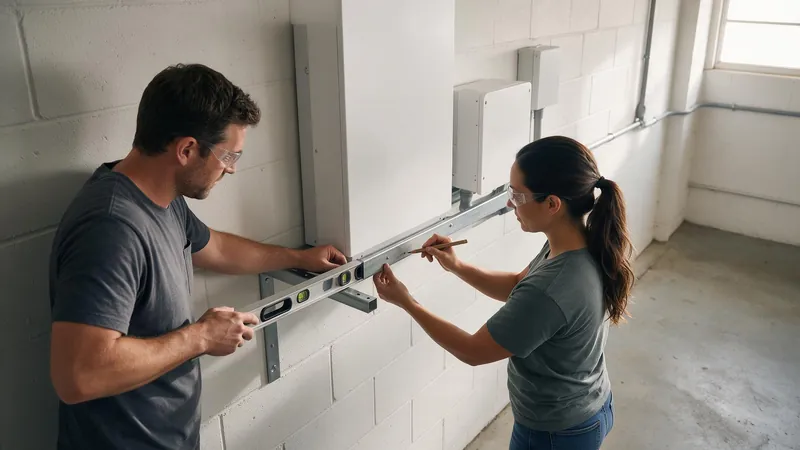
The jobs
01Inverter and battery on a garage wall
A bracket with four or more anchors: scan along each row of holes, then across it.
02Cable entry through the wall
DC or AC cables from outside to the inverter. Hidden cables do not show on the surface: scan the route.
03Fixings into a flat concrete roof
Ballast or anchors into the deck. Before drilling a roof slab, know how thick it is and what is in it.
Try the job in 3D
A 200 mm concrete wall with mesh on both faces and three anchor marks for a rail: think of it as an inverter or battery bracket. Scan one line along the marks, then rotate 90 degrees: in this model, one line each way shows the whole mesh.
One situation from the Scan lab, which has all eleven.
How pros do it
- Read the mounting appendix for your wall. For Powerwall 3 on solid concrete, Tesla asks for a minimum strength of 2500 PSI and at least four 3/8 inch concrete anchors with at least 2 1/2 inch embedment1. On block, no anchors within 12 inches (305 mm) of wall edges or 1 1/2 inches (38 mm) of block edges, and "Fasteners shall not be installed in mortar joints"1.
- The installer picks the fixings. Fronius makes the installer responsible for choosing the mounting materials2. SMA asks for a solid support surface, such as concrete, masonry or a free-standing construction; on drywall the inverter emits audible vibrations3.
- Flat roofs: weight, or fixings into the deck. The ballast a fully ballasted system needs often exceeds the building's structural capacity4. Where the system is fixed instead, a roof attachment engineer wants the structural load on the deck, not on the waterproofing or membrane layer4.
From the trade sources listed below, opened 17 November 2026. They describe professional practice in general, not Eagle XR.
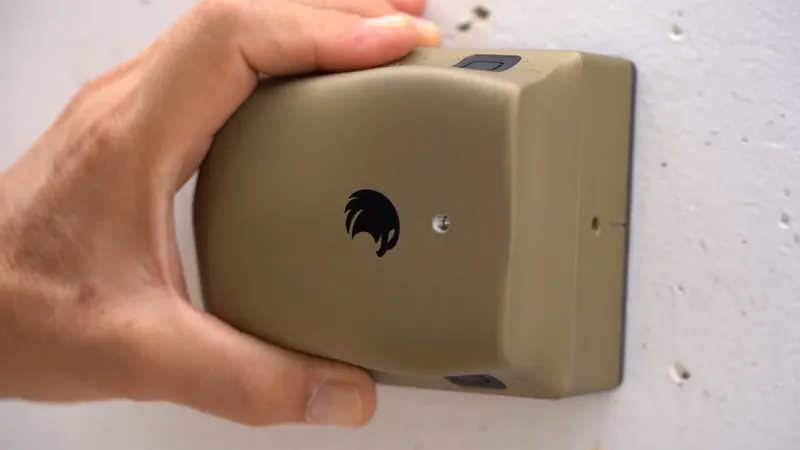
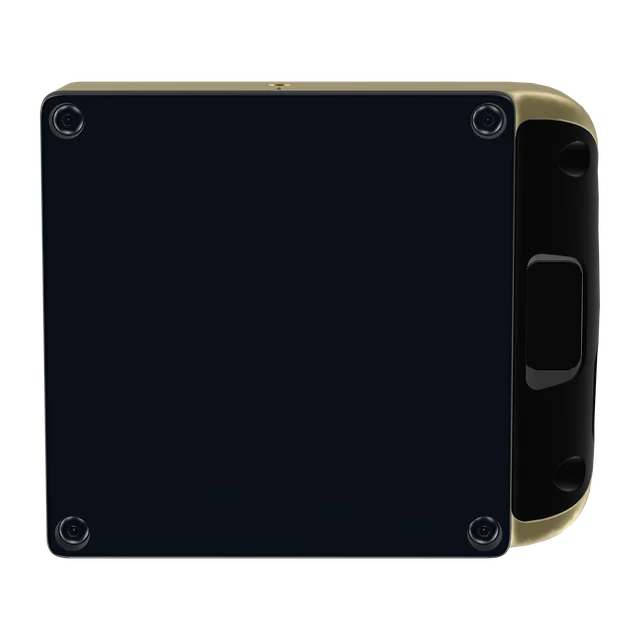
This side goes flat on the surface.
Where Eagle XR fits
- Walls, slabs, columns and corners5. Materials: concrete (dry, normal or wet), drywall, and masonry (brick and block) in the App Store listing6; the product page says Eagle Intelligence is trained on concrete and learning more materials5.
- It lists electric cables and conduits, water pipes and rebar, each in colour at its depth6.
- It scans one line at a time, in one direction: you slide it forward along the line, lift it, and start the next line.
- Scans are saved, synced and shareable5, and the listing describes taking a screenshot, marking it up on your phone and sending it to the team6.
Where it does not
- Wall strength in PSI, and whether an anchor holds, are not scan results: the manual and the anchor maker set the requirements.
- Roof membranes, insulation build-ups and foil-backed layers are not addressed in Screening Eagle's published facts.
- Screening Eagle has not published whether it tells you a cable is live. Treat every cable as live: isolate and prove dead before you drill near one. Hilti, for comparison, lists live wires among what its PS 1000 finds7. Ask Screening Eagle before you order if that matters for your job.
- Eagle XR is not a GPR: Screening Eagle calls it a first look for everyday work, to see whether a spot is clear or whether to call an expert. For investigations, mapping and reports, it points professionals to GPR systems5.
Questions solar and home battery installers ask
What is the right solar inverter mounting height?Manufacturer manuals
Use the height and clearances in your inverter's manual. The manuals we read stress access: SMA wants the site freely and safely accessible at all times without scaffolding or lifting platforms, and the DC load-break switch always freely accessible3. Fronius says not to install the inverter on the ceiling2.
What fixings does a solar inverter mounting bracket need on concrete?Manufacturer manual
Whatever your manual and the anchor maker specify for that wall. Fronius, for example, recommends steel or aluminium screws of 6 to 8 mm diameter2.
Can a home battery go on a block or brick wall?Tesla manual, not published
For Powerwall 3, Tesla has separate rules for block and for brick. The block rules are in the first step above. On brick, the brick depth must be verified as nominal 4 inch, and units on brick "shall be ground-mounted on a suitable foundation"1. Eagle XR shows the back of the element5; its depth accuracy is not published.
Battery in the garage: what should I watch for?Tesla manual, BSI
Watch for vehicles first, then flooding. Tesla says to keep Powerwall out of the driving path, if possible on a side wall and/or above bumper height, and in a location that prevents damage from flooding8. In the UK, PAS 63100:2024 covers where home batteries are installed, in respect of safety and the external influences that affect fire safety9.
Solar installer drilling into a concrete flat roof: what should I know?General
You weigh the array down with ballast, fix it into the deck, or combine the two, and each is a structural question. Find out whether the slab is post-tensioned: on a PT slab, the engineer decides.
How do I avoid hidden cables when drilling for the inverter or the cable entry?NICEIC, trade article
Know where cables are allowed to run, and do not assume they stay there. In UK practice, hidden cables may run within 150 mm of the top of the wall or of a corner, as NICEIC summarised BS 767110. In Australia, a licensed electrician writes that wiring can be laid in a channel carved into a masonry wall and plastered over11. The same article shows a cable in a tile roof hit by a bracket screw, "rendered invisible by a conductive layer of foil sarking"11.
Anything else: search every answer on this site on Before you buy, or ask Screening Eagle directly.
Ready for your own job?
CHF 3,950per scanner, excluding VAT, import taxes and delivery. Ordering happens on Screening Eagle's shop.
Buy in Solar GoldPartner link: we may earn a commission. You pay Screening Eagle's normal price.
- Sold and shipped by Screening Eagle
- Same price in all four finishes
- Card, Apple Pay or Google Pay
- Express shipping from Switzerland. US orders ship from Pennsylvania
Sources
- Tesla, Powerwall 3 installation manual, Wall Bracket Anchoring Details for Wall-mounting, read 17 November 2026, energylibrary.tesla.com
- Fronius, Galvo 208-240 installation manual (online), read 17 November 2026, manuals.fronius.com
- SMA, Sunny Tripower Hybrid X manual, Requirements for the Mounting Location, read 17 November 2026, manuals.sma.de
- Solar Power World, Penetrations don't have to be the enemy of flat-roof solar (2017), read 17 November 2026, solarpowerworldonline.com
- Screening Eagle, Eagle XR product page and FAQ, read 15 November 2026, xr.screeningeagle.com
- Apple App Store, Eagle XR listing by Screening Eagle Technologies AG, read 15 November 2026, apps.apple.com
- Hilti New Zealand, How to choose the right detection tool, read 16 November 2026, hilti.co.nz
- Tesla, Powerwall installation manual, Site Requirements and Pre-Installation Guidance, read 17 November 2026, energylibrary.tesla.com
- BSI, PAS 63100:2024 Protection against fire of battery energy storage systems for use in dwellings, product page, read 17 November 2026, accord-checkout.bsigroup.com
- NICEIC, Cables concealed in walls or partitions: protection against penetration (BS 7671:2008 article), read 17 November 2026, tlc-direct.co.uk
- SolarQuotes blog, Another Day, Another Near Death Experience In Solar, 29 September 2026, read 17 November 2026, solarquotes.com.au