Home / Jobs / TV and AV installers
Jobs for TV and AV installers
TV wall mounting on concrete
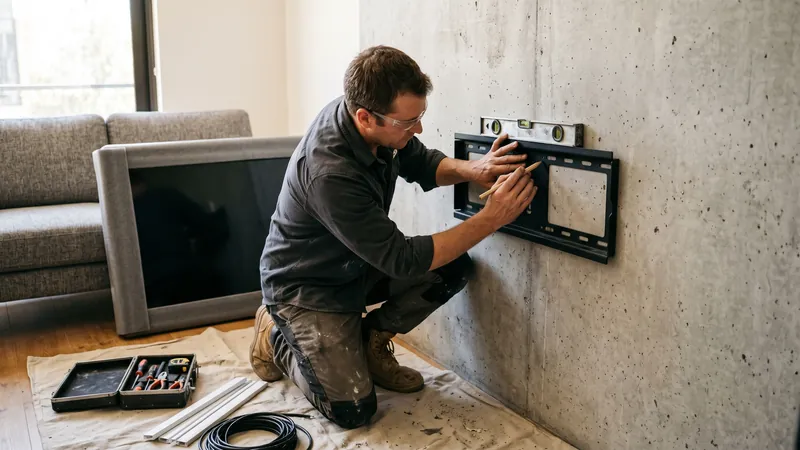
A large screen on the concrete wall of a new flat, a projector overhead, speakers on a block wall, and a customer who wants no wires showing. The bracket manuals cited below call for holes 70 to 108 mm deep, and the obvious spot is right above a socket, in the zone where its cable is allowed to run. A drilled cable or pipe in a customer's living room is a call-back, or a claim.
Before you mount a TV on concrete
Stop and call an electrician or the building's engineer if
- a cable near the holes cannot be isolated and proved dead
- the ceiling for a projector or speakers may be post-tensioned
- you want a chase in a cast concrete wall of a block of flats
The short version of this page. The details and sources follow below.
From TV wall mounting on concrete: drillclear.com/jobs/tv-and-av-installers, where every step has its sources.
- US
- TV mounting, wall plate, lag bolts, in-wall power kit, conduit, low voltage
- UK
- TV bracket, wall plate, rawlplugs, dot and dab, chasing, back box, trunking
The jobs
01A TV bracket on a concrete wall
Bracket makers set a minimum wall and a hole depth, and that depth can reach past the bars near the face. Scan lines across the wall plate area, then at 90 degrees to them, before you mark the holes.
02Hiding the wires in a solid wall
A chase runs along the same zones as the cables already in the wall, so scan the whole route, not only the bracket.
03A projector or speakers on a concrete ceiling
Ceiling mounts take heavy bolts overhead. In a post-tensioned slab the tendons usually drape lowest at midspan, close to the soffit: stop and ask the engineer.
Try the job in 3D
A 200 mm concrete wall with mesh on both faces and three anchors marked on one line, labelled for a shelf rail: read it as the top row of a TV wall plate. Scan along the line, then rotate 90 degrees and scan again.
One situation from the Scan lab, which has all eleven.
How pros do it
- Read the bracket manual for the wall. Sanus asks for solid concrete at least 203 mm (8 in.) thick or block of at least 203 x 203 x 406 mm, and a wall that can carry five times the weight of the TV and mount combined1. It also says never to drill into the mortar between blocks1.
- Expect a cable above and below the socket. In the UK, a cable less than 50 mm deep may run within 150 mm of the top of the wall or of a corner, or "either horizontally or vertically, to the point accessory or switchgear"2. Walls are where other trades meet the risk of drilling into one2.
- Chase and power within the rules. For masonry walls in England, Approved Document A says vertical chases should go no deeper than 1/3 of the wall thickness (in cavity walls, of the leaf) and horizontal ones no deeper than 1/6 of the leaf, and no chase should impair the stability of the wall, particularly with hollow blocks3. In the US, "It is an NEC code violation to install flexible cord in a wall"4: the TV power cord stays out of it.
From the trade sources listed below, opened 17 November 2026. They describe professional practice in general, not Eagle XR.
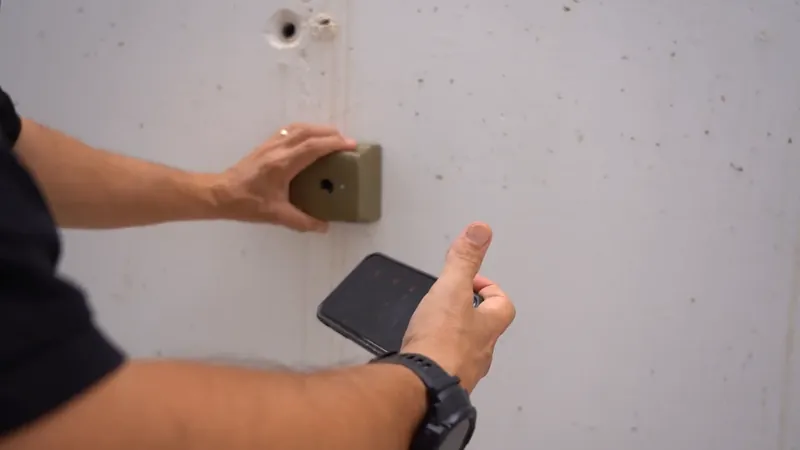
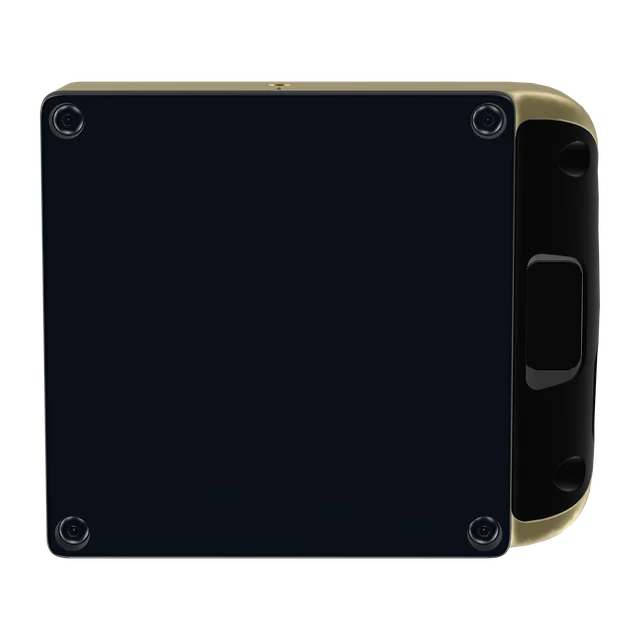
This side goes flat on the surface.
Where Eagle XR fits
- One sweep across a wall, ceiling or floor5. The sensor weighs 750 g and, at 100 x 90 mm, is made to fit in tight corners6.
- It lists electric cables and conduits, rebar and plastic water pipes, each in colour at its depth7, on concrete (dry, normal or wet), drywall, and masonry (brick and block) in the App Store listing7; the product page says Eagle Intelligence is trained on concrete and learning more materials6.
- A stated depth of up to 40 cm in concrete6, deeper than any of these bracket holes, and it shows the back of the element6: a first idea of the wall's thickness.
- It scans one line at a time, in one direction: you slide it forward along the line, lift it, and start the next line.
- Scans are saved, synced and shareable6, and the listing describes taking a screenshot, marking it up on your phone and sending it to the team7: a picture of the wall in the job file before the first hole.
Where it does not
- Whether it tells a live cable from a dead one has not been published. Treat every cable as live: isolate and prove dead before drilling near one, and if you cannot, stop and call an electrician.
- Tiles and foil-backed board are not addressed in Screening Eagle's published facts.
- Depth accuracy is not published, so a back-wall reading near the bracket maker's minimum thickness, such as 203 mm for Sanus, is a reason to choose another wall or ask, not a sign-off.
- Eagle XR is not a GPR: Screening Eagle calls it a first look for everyday work, to see whether a spot is clear or whether to call an expert. For investigations, mapping and reports, it points professionals to GPR systems6.
Questions TV and AV installers ask
Can you mount a TV to a concrete wall?Bracket manual
Yes, if the wall and the fixings suit the load and the bracket allows it. Follow the manual of the bracket you fit; the Sanus rules in the first step above are one example. A scan gives a first look at the other question: whether bars, conduits or pipes sit where the holes go.
How do you hide the wires when you mount a TV on a concrete wall?Regulations
A bare concrete wall has no cavity to fish through, so it is usually a chase in the wall or surface trunking. The chase depth limits and the US rule on power cords are under How pros do it. A chase in a cast concrete wall of a block of flats is a question for the building's engineer or managing agent first.
How deep do TV bracket anchor holes go in concrete?Bracket manuals
Deeper than many expect: 70 mm and 9.5 cm into concrete in the manuals we read, and 108 mm on a dot and dab wall. Sanus gives 8 mm pilot holes 70 mm (2.75 in.) deep for the VML44A in concrete, and 108 mm on a dot and dab wall with up to 50 mm between board and wall1. A Sanus arm mount, the BLF328, goes to 3 ¾ in. (9.5 cm)8: in a 200 mm wall, that is nearly half way through.
Does it work through dot and dab plasterboard?Not published
Not published. Ask Screening Eagle before you order if your job depends on it. How it reads plasterboard on adhesive dabs, with an air gap behind it, has not been published; the materials it lists are under Where Eagle XR fits.
What about a projector mount on a concrete ceiling?Mount manual
Use the bolts the mount maker asks for, and let the engineer decide on a post-tensioned slab. Epson's ceiling mount manual asks for M12 or larger nuts and bolts in concrete, notes that projector and mount together may weigh as much as 10 to 20 kilograms, and assumes the work is done by a specialist with the required know-how9. Precast planks have their own rules: see the hollowcore guide.
Drilling through an outside wall for an aerial or satellite cable?Safety regulator
Look where the electrical service comes in first. Ontario's Electrical Safety Authority reported "an alarming trend in incidents involving communication installers drilling into, or making contact with, electrical wiring"10. One was a hole through clay brick beside the service entrance that started an electric arc and a fire. Its advice is to measure inside and outside the structure before drilling holes10.
Anything else: search every answer on this site on Before you buy, or ask Screening Eagle directly.
Ready for your own job?
CHF 3,950per scanner, excluding VAT, import taxes and delivery. Ordering happens on Screening Eagle's shop.
Buy in Solar GoldPartner link: we may earn a commission. You pay Screening Eagle's normal price.
- Sold and shipped by Screening Eagle
- Same price in all four finishes
- Card, Apple Pay or Google Pay
- Express shipping from Switzerland. US orders ship from Pennsylvania
Sources
- Sanus, VML44A TV wall mount instruction manual (2024), read 17 November 2026, sanus.com
- Professional Electrician, What is a Cable Safe Zone? (23 October 2018), read 17 November 2026, professional-electrician.com
- HM Government, Approved Document A: Structure (England, 2013 online version), paragraph 2C30 on chases in masonry walls, read 17 November 2026, assets.publishing.service.gov.uk
- Legrand Wiremold, CMK70 Flat Screen TV Cord and Cable Power Kit FAQ, hosted by distributor Accu-Tech, read 17 November 2026, accu-tech.com
- Screening Eagle, Eagle XR launch press release, 17 September 2026, screeningeagle.com
- Screening Eagle, Eagle XR product page and FAQ, read 15 November 2026, xr.screeningeagle.com
- Apple App Store, Eagle XR listing by Screening Eagle Technologies AG, read 15 November 2026, apps.apple.com
- Sanus, BLF328 TV wall mount instruction manual (2019), read 17 November 2026, sanus.com
- Epson, Ceiling Mount ELPMB22/ELPMB23 instruction manual, hosted by retailer Project Isle, read 17 November 2026, projectisle.com.au
- Electrical Safety Authority (Ontario), Flash 22-23-FL, Installation of communication wiring around electrical equipment (May 2022), read 17 November 2026, esasafe.com