Home / Jobs / Lift and elevator installers
Jobs for lift and elevator installers
Concrete scanning for lift and elevator installers
A template on the shaft wall, two anchors per bracket, bracket after bracket up the hoistway. In a concrete shaft, every bracket anchor needs a hole in a reinforced wall.
Before you fix guide rail brackets
Stop and call the engineer of record if
- you hit reinforcing bars while installing an anchor
- the layout is fixed and a bracket still lands on steel
- anchor type, embedment or edge distance is in question
The short version of this page. The details and sources follow below.
From Concrete scanning for lift and elevator installers: drillclear.com/jobs/elevator-installers, where every step has its sources.
- US
- hoistway, guide rail brackets, rail clips, pit, entrance
- UK
- lift shaft, guide rail brackets, fixings, pit, landing
The jobs
01The bracket layout on a shaft wall
Scan before the template is fixed: a bracket that lands its anchors on bars can still slide.
02Landing entrance fixings
Sill and entrance anchors go into the slab edge and the wall: the same check, one landing at a time.
03Anchors in the pit
Buffer and rail base fixings go into the pit slab, scanned from the one face you can reach.
Try the job in 3D
Two brackets, two anchors each. Scan the bracket line: the holes are drawn on the picture to their depth. Bracket B lands on bars.
One situation from the Scan lab, which has all eleven.
How pros do it
- Leave room to move. Scan each anchor location over enough area to move the hole1.
- Two directions per bracket. ABC Central Texas calls it best practice to scan each planned hole in two directions at right angles2.
- Hit steel? Tell the engineer. Hilti recommends telling the engineer of record, who decides how to proceed and where the anchors go3.
- Mark every point. An X or a circle for a confirmed point4, and the bars around it, so the next bracket goes faster.
From the trade sources listed below, opened 16 November 2026. They describe professional practice in general, mostly with GPR, not Eagle XR.
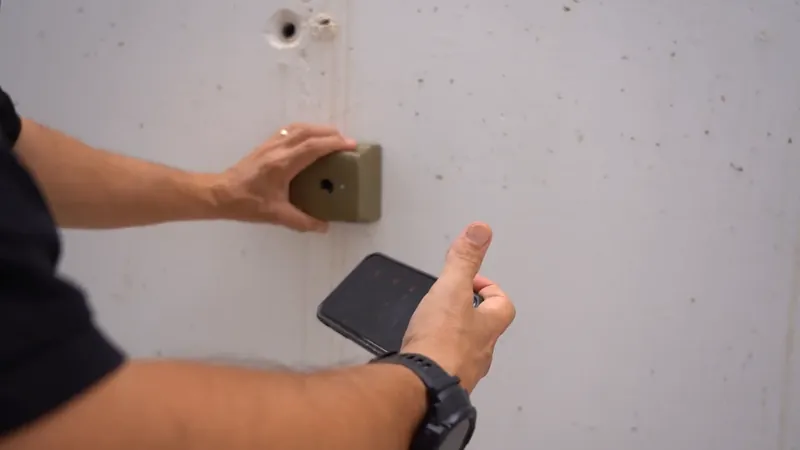
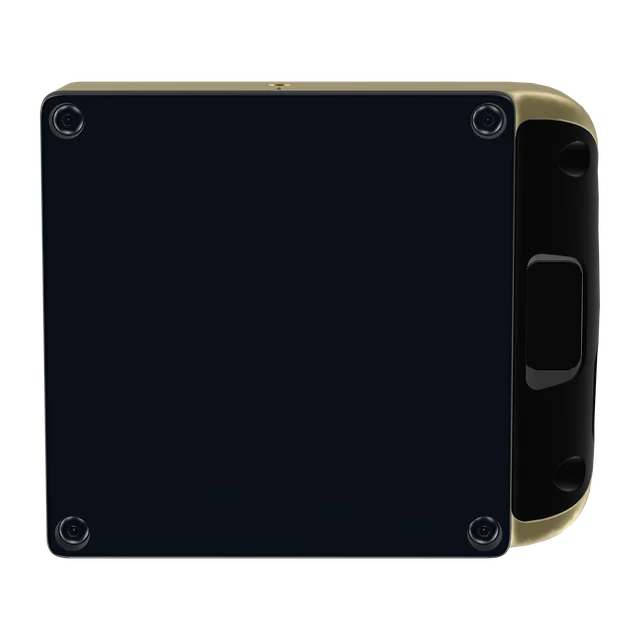
This side goes flat on the surface.
Where Eagle XR fits
- Made for walls and corners: at 100 by 90 mm, the sensor fits in tight corners5.
- One hand, one sweep6, and a 750 g sensor5: that counts on a platform or the car roof.
- Rebar (every bar, every layer), conduits and the back wall7, to a stated 40 cm in concrete5.
- Scans are saved, synced and shareable5, and you can screenshot one, mark it up and send it to the team7.
Where it does not
- Anchor type, embedment and edge distances are engineering decisions, not scan results.
- Bar size: not published for Eagle XR, and radar in general cannot reliably determine bar diameter8.
- Not a GPR: a first look for everyday work, to see whether a spot is clear or whether to call an expert; for investigations, mapping and reports, Screening Eagle points professionals to GPR systems5.
Questions lift and elevator installers ask
Will it see both layers of bars behind a bracket?App Store listing, general
Screening Eagle says yes, but with radar in general the top layer of bars can hide deeper objects. Penhall makes that point4; if a deep bar matters for your anchor depth, scan more lines and ask the engineer.
What if a bracket anchor lands on a bar?General
Before the layout is fixed, slide the bracket to clear the steel; after that, the engineer of record decides where the anchors go.
Can it check the shaft wall thickness?Product page, not published
It shows where the wall ends, but how accurate that is has not been published.
Our shafts are block (CMU). Does it work?App Store listing, product page
Masonry is listed, but Screening Eagle says its intelligence is trained on concrete and still learning more materials. Brick and block are on the App Store list next to concrete and drywall7; the training note is on the product page5.
Will it fit between the rail and the wall?Product page, App Store listing, not published
That depends on your gap: the sensor is 100 by 90 mm, and its thickness has not been published. Your phone is the display7.
Does it work in a cold or wet pit?App Store listing, not published
Wet concrete is listed, but an operating temperature and an IP rating have not been published. The listing says dry, normal or wet7.
Anything else: search every answer on this site on Before you buy, or ask Screening Eagle directly.
Ready for your own job?
CHF 3,950per scanner, excluding VAT, import taxes and delivery. Ordering happens on Screening Eagle's shop.
Buy in Solar GoldPartner link: we may earn a commission. You pay Screening Eagle's normal price.
- Sold and shipped by Screening Eagle
- Same price in all four finishes
- Card, Apple Pay or Google Pay
- Express shipping from Switzerland. US orders ship from Pennsylvania
Sources
- Trinity Subsurface, Scanning Post-Tension Slabs Before You Core or Cut, read 16 November 2026, trinitysubsurface.com
- Associated Builders and Contractors, Central Texas chapter, GPR Concrete Scanning Before the Core Drill Starts, read 16 November 2026, abccentraltexas.org
- Hilti USA Engineering Center, Hitting Rebar In Cooling Tower Basin during Epoxy anchor installation, read 16 November 2026, hilti.com
- Penhall, Slab Scanning 101: When You Need It and What it Includes, read 16 November 2026, penhall.com
- Screening Eagle, Eagle XR product page and FAQ, read 15 November 2026, xr.screeningeagle.com
- Screening Eagle, Eagle XR launch press release, 17 September 2026, screeningeagle.com
- Apple App Store, Eagle XR listing by Screening Eagle Technologies AG, read 15 November 2026, apps.apple.com
- SPH Engineering, GPR Scanning in Concrete to Find Rebar, PT Cables and Voids, read 16 November 2026, sphengineering.com