Where do cables and pipes run in walls and floors?
Wiring rules say where cables should run in a new wall. They differ by country, they cover only some cables, and they say little about concrete or about what a previous owner did.
Before you drill near hidden cables and pipes
Stop and call an electrician if
- the bit touches a cable, or a switch trips as you drill
- you cannot confirm that the power is off
The short version of this page. The details and sources follow below.
From Where do cables and pipes run in walls and floors?: drillclear.com/guides/where-are-cables-and-pipes-in-walls, where every step has its sources.
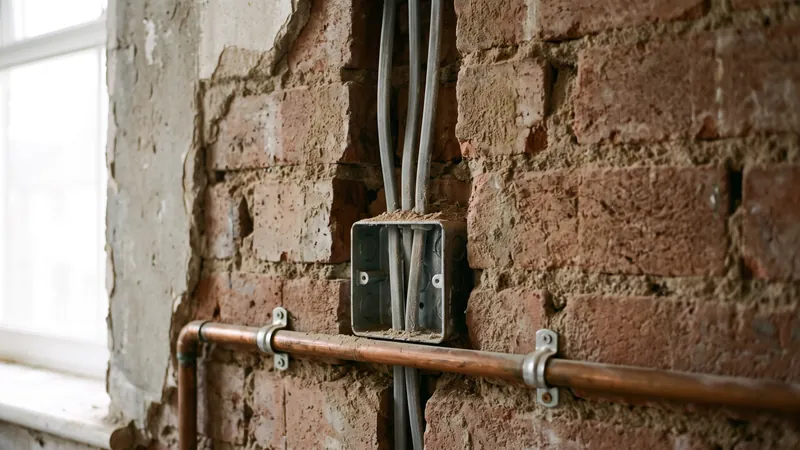
Where do electrical wires run in walls in the UK?
In the UK, shallow cables must run straight up, down or across from an accessory, or near the top of a wall or a corner. Under BS 7671, the rule covers a cable buried less than 50 mm deep without earthed metal or mechanical protection: it must run within 150 mm of the top of the wall, within 150 mm of a corner where two walls meet, or horizontally or vertically to an accessory, point or item of switchgear1.
On a real wall (our drywall, brick and block guide has the rule in a table):
- Every socket, switch, spur and fused connection unit has a band straight above it, straight below it and straight across from it.
- Along the ceiling line and down every corner runs a 150 mm band.
- The other side counts too. Where you can tell the position of an accessory from the reverse side of a wall or partition less than 100 mm thick, the zone extends to that side as well1.
- Partitions with internal metal parts, such as metal studs, need an RCD or one of the specified protective methods for cables at any depth (Regulation 522.6.203)1.
A cable 50 mm deep or more, or in earthed metal conduit or armour, is not bound to the zones at all1.
Should cables be protected in walls?
In the UK, yes. NICEIC explains that cables less than 50 mm below the surface can be vulnerable to nails, screws and the like. A cable at that depth that is not in earthed armour, earthed conduit, mechanical protection or similar needs additional protection by an RCD of not more than 30 mA, and it must still run in the zones1.
An RCD limits the harm. It does not stop you hitting the cable, and homes wired to older editions may not have one. If you have hit one, read I drilled into a wire or a water pipe.
Where do electrical wires run in US walls?
US rules protect cables by distance from the framing, not by routes on the wall. Where a cable passes through a bored hole in wood, the edge of the hole must be at least 1 1/4 in from the nearest edge of the wood, or the cable is protected by a steel plate or bushing at least 1/16 inch thick. A cable run parallel to framing needs the same clearance or a plate. The rule is NEC 300.4 in the 2023 edition and 300.6 in the 2026 edition6.
The aim, as IAEI Magazine puts it, is to protect wiring from damage and from possible fastener penetration6: where a screw into a stud would reach it. The rule does not fix the height or direction of a run between studs.
Two cases need extra care. Furring strips on a block wall are normally only 3/4 in thick, so the clearance cannot be met there6. And NM house cable is not cast into concrete: the NEC says "Types NM, NMC, and NMS cables shall not be embedded in poured cement, concrete, or aggregate"7. Wiring cast into a US concrete wall or slab was laid before the pour, by another wiring method. Later runs may sit in chases or drilled routes.
German installation zones: DIN 18015-3
DIN 18015-3 is the German standard for where concealed cables go in homes. The current edition is DIN 18015-3:2016-09, which replaced the 2007 edition. Its purpose is to keep concealed cables in certain fixed zones (bestimmte festgelegte Zonen), so other trades and later work do not damage them5.
A trade journal summary of the 2007 edition gives the zones4:
| Where | Zone |
|---|---|
| Walls, horizontal | 30 cm wide: 15 to 45 cm below the ceiling, 15 to 45 cm above the finished floor, and 100 to 130 cm above the floor in rooms with worktops |
| Walls, vertical | 20 cm wide: 10 to 30 cm beside door and window openings and wall corners |
| On the floor slab, under the screed | Parallel to the walls, at most 30 cm wide, at least 20 cm from the wall, 15 cm in doorways, and 20 cm from other trades' zones |
| Under the ceiling | In or under plaster, in cavities or suspended ceilings: parallel to the walls, at least 20 cm from them |
| Inside the concrete slab | weiterhin frei wählbar: the route remains free to choose |
The article adds that routes should follow the zones where possible, that the standard does not cover surface wiring, trunking or raised floors, and that in stud walls cables may not run inside the metal profiles. Sockets in the lower zone have a preferred height of 30 cm4. DIN's own page lists changes in 2016, including a redefined ceiling zone and new outdoor zones5, so check the current text before you rely on a figure.
Why concrete walls and floors break the pattern
Most zones describe cables near the surface, but in a concrete building many runs are cast in: conduits fixed to the reinforcement before the pour. A UK conduit 50 mm or more deep can run anywhere, a German route inside the slab can be a diagonal from a ceiling light to the nearest wall, and the US clearance rules, measured from framing and furring6, set no route through a slab.
Then there is everything done after the electrician left: a cable a previous owner added, a run moved during a kitchen refit, or work done before the rule existed. As the UK Health and Safety Executive (HSE) puts it: "Even if you do see wires, there may be others you cannot see"3.
Where do water pipes run in walls and floors?
We found no zone rule for water pipes like the one for cables. Under the Water Supply (Water Fittings) Regulations 1999, "No water fitting shall be embedded in any wall or solid floor", and no joint may be a concealed fitting8. Water Regs UK treats fittings installed below or embedded in floors, or in or behind wall finishes, as concealed9. Those rules say how pipes should be laid, not where a pipe is, and older buildings predate them.
Trace pipes from where they show: the stop tap, sinks, radiators, the boiler, the toilet and, for underfloor heating, the manifold. In a German floor, DIN 18015-3 asks planners to allow for water and heating pipes beside the cable zone4. A metal detector will not see plastic pipes and heating loops: read how to find plastic pipes and underfloor heating.
How to check for pipes and wires before drilling
Map the zones, look on both sides, detect or scan, and switch off: none of these is certain, but together they stack the odds.
The HSE says to look on both sides of walls, to trace where nearby equipment is wired and to ask to see plans of the electrical installation; in a flat, the building manager may have them. It also warns that "some cable detectors won't find a wire carrying a small current"3. Electrical Safety First says a quality cable detector can help track buried cables, and to switch off at the fuseboard and, where possible, use only battery-powered tools, then check the power is off by plugging an appliance in or trying the lights2. What each detector reaches is in stud finders on concrete; the full order of work on concrete is in how to drill into concrete safely. Try the socket case in the Scan lab.
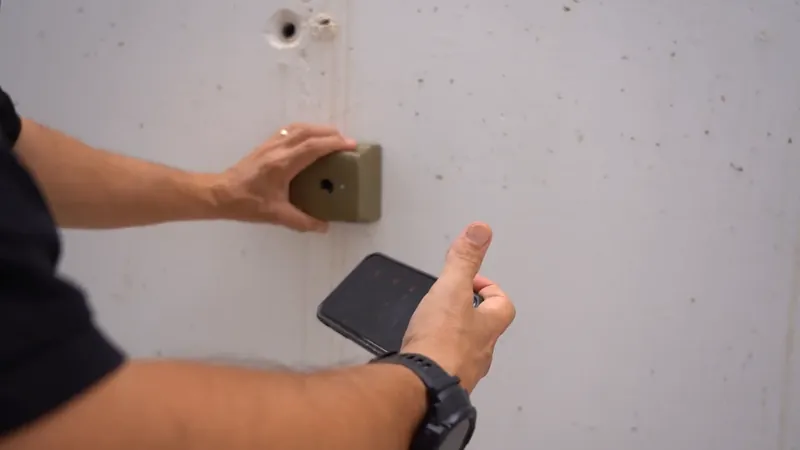
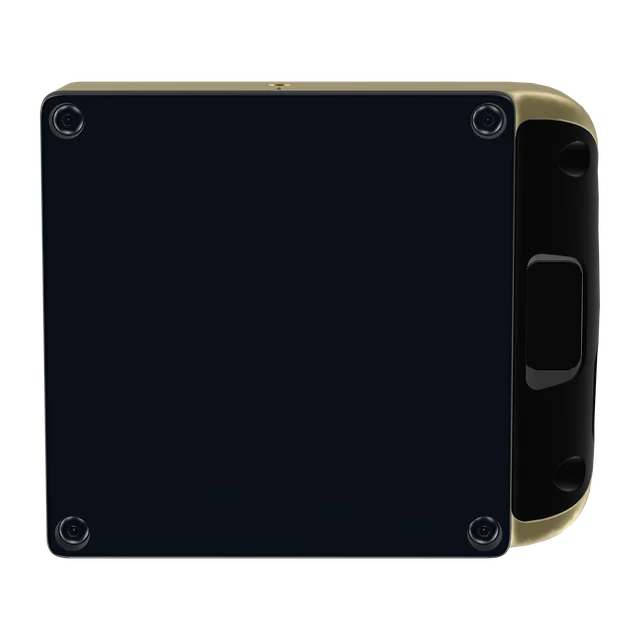
This side goes flat on the surface.
Where Eagle XR fits
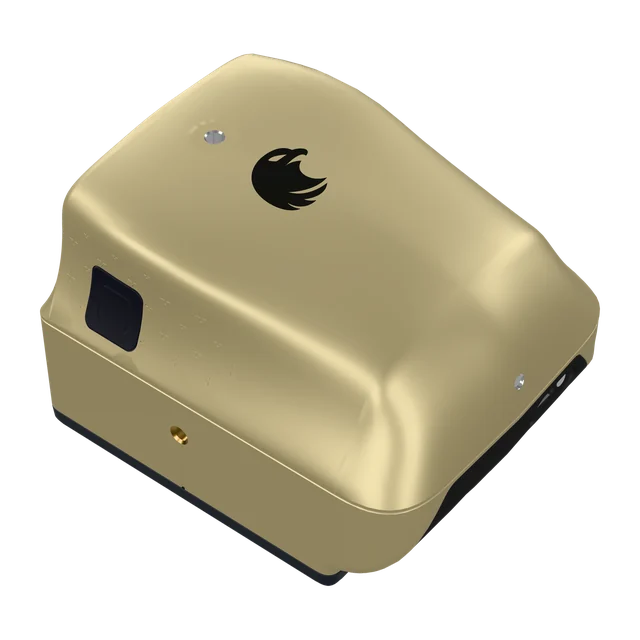
Eagle XR can show cables and pipes in a wall, one scan line at a time, but no scan is a guarantee. Its App Store listing names electric cables and conduits, and water pipes including non-metallic PEX and PVC10. The product page lists rebar, cables, plastic pipes and air voids, shown in color at their depth, and gives 40 cm as its depth in concrete11. It pairs with your phone and scans in one direction. A horizontal line crosses a vertical cable above a socket, and a vertical line crosses a horizontal run, so scan one line of each kind.
Whether it tells a live cable from a dead one is not published, so treat every cable it shows as live. Screening Eagle calls it "a first look for everyday work", not a GPR, and says it does not replace an expert11.
Want to see inside before the next hole?
Eagle XR is a pocket concrete scanner that pairs with your phone and shows rebar, cables, plastic pipes and air voids at their depth. Stated depth in concrete: up to 40 cm. CHF 3,950 excluding VAT, import taxes and delivery.
Buy in Solar GoldPartner link: we may earn a commission. You pay Screening Eagle's normal price.
- Sold and shipped by Screening Eagle
- Same price in all four finishes
- Card, Apple Pay or Google Pay
- Express shipping from Switzerland. US orders ship from Pennsylvania
Sources
- NICEIC in Professional Electrician, Why contractors need to apply due diligence when installing cables embedded in thin walls or partitions (BS 7671 Regulations 522.6.202 to 522.6.204), 14 August 2023, read 17 November 2026, professional-electrician.com
- Electrical Safety First, Advice for DIY-ers, read 17 November 2026, www.electricalsafetyfirst.org.uk
- UK Health and Safety Executive, Work near electricity, read 17 November 2026, www.hse.gov.uk
- Werner Baade, de (das elektrohandwerk) 21/2007, Neue Norm für elektrische Anlagen in Wohngebäuden: DIN 18015-3:2007-09, read 17 November 2026, elektro.net
- DIN Media, DIN 18015-3:2016-09 Elektrische Anlagen in Wohngebäuden, Teil 3: Leitungsführung und Anordnung der Betriebsmittel, standard page, read 17 November 2026, www.dinmedia.de
- Vince LaPorta, IAEI Magazine, NEC 300.4 Protection against physical damage, 1 January 2026, read 17 November 2026, iaeimagazine.org
- Mike Holt, EC&M Code Quiz, Locations where NM cable is not allowed (NEC 334.12(A)(9)), 27 January 2015, read 17 November 2026, www.ecmweb.com
- The Water Supply (Water Fittings) Regulations 1999, Schedule 2, paragraph 7, legislation.gov.uk, read 17 November 2026, www.legislation.gov.uk
- Water Regs UK, Guidance to Schedule 2 paragraph 7: pipework, read 17 November 2026, www.waterregsuk.co.uk
- Apple App Store, Eagle XR listing by Screening Eagle Technologies AG, read 17 November 2026, apps.apple.com
- Screening Eagle, Eagle XR product page and FAQ, read 17 November 2026, xr.screeningeagle.com