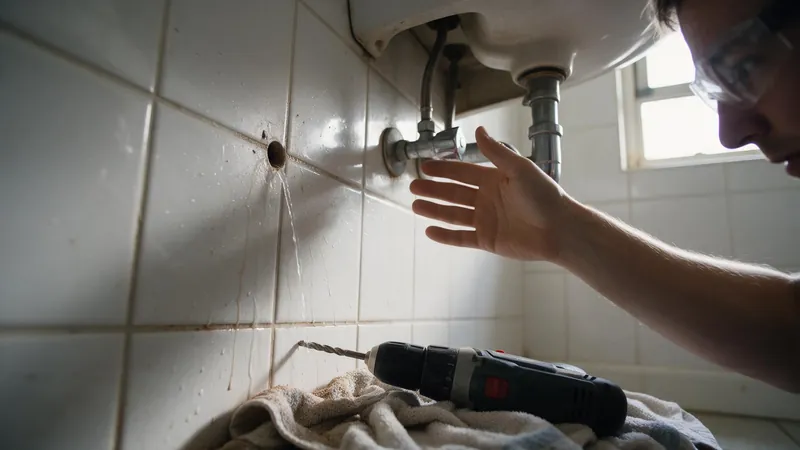
I drilled into a wire or a water pipe. What now?
Stop, let go of the drill if it is safe to, and keep your hands off the bit and the hole. What comes next depends on what you hit: electricity, water, gas or underfloor heating.
Before you touch the drill after a hit
Stop and call an electrician or a plumber if
- a breaker or RCD tripped as you drilled
- a drill bit, screw or nail went into a cable
- water comes out of the hole, from a supply or a drain pipe
The short version of this page. The details and sources follow below.
From I drilled into a wire or a water pipe. What now?: drillclear.com/guides/drilled-into-a-wire-or-pipe, where every step has its sources.
If someone is getting a shock: Electrical Safety First says "Never touch the person receiving the electric shock while they are still in contact with the electricity source." The best way is to turn off the supply. If you cannot, use a dry, non-conductive material, such as a length of wood, to take the source off the person. "If the person is unconscious, call 999 immediately" (911 in the US). "Only attempt first aid that you are trained and confident to carry out."1
What happens if you drill into a wire?
It depends on what the bit touches and what protects the circuit. If it reaches a live conductor, you risk a shock through the drill or the bit. An RCD, or a GFCI in the US, may switch the circuit off in a fraction of a second. A breaker may trip or a fuse may blow. Or nothing visible happens, and a damaged cable stays in the wall.
Electrical Safety First lists drilling into wiring among common DIY mistakes, and says an RCD can save your life by switching off the power quickly if there is an electrical fault2. If a switch trips as you drill, assume the bit hit the cable. No trip does not tell you the cable is fine.
Accidentally drilled into an electrical wire: what to do
Keep away from the bit and the hole, switch the circuit off at the consumer unit (fuse box) or breaker panel, and call an electrician.
- Hands off. Do not pull the bit or screw out while the circuit may be live.
- Switch off at the board. Electrical Safety First's advice is to switch off the power at your fuseboard2. If you do not know which circuit it is, use the main switch.
- Keep it off. The HSE's rule for work near wiring is that once the supply is off, it stays off and cannot be restored without your agreement3. If an RCD or breaker tripped, leave it down. Do not reset it to see whether the circuit still works.
- Call an electrician. Electrical Safety First says electrical work should be left to competent professionals2. Leave the hole as it is, so they can see where the bit went.
Older consumer units may have no RCD, so a hit cable may trip nothing at all. Electrical Safety First says that alone does not necessarily make them unsafe or in need of an upgrade, and an electrical installation condition report (EICR) shows whether the unit is still safe4.
Drilled a screw into an electrical wire
Treat a screw, nail or picture hook the same way as a drill bit. Switch the circuit off before you touch it, and let an electrician decide how to take it out and repair the cable. The risk Electrical Safety First names is drilling, nailing or screwing close to cables in the wall2, so last week's picture hook counts too.
What do RCDs and GFCIs do?
They switch a circuit off fast when current leaks to earth, for example through a person. They do not stop you hitting a cable, and not every circuit has one.
- GFCI (US). The US Consumer Product Safety Commission says a GFCI trips when the current going out and coming back differ by as little as 0.006 amperes, and cuts the power faster than a blink of an eye. The NEC added GFCI receptacles room by room: outdoors from 1973, bathrooms 1975, garages 1978, kitchens 1987, among others, and typically applies only to new construction and major renovations5. A bedroom circuit in an older US home may have none.
- UK. A cable buried less than 50 mm deep in a wall, without earthed metal or mechanical protection, needs an RCD of not more than 30 mA under BS 7671, and must still run in the zones6.
- Test them. On a UK board, pressing the test button on an RCD switches off the power to the areas of the home it protects4. The CPSC says to test every GFCI at least once a month5.
Drilled through a water pipe in the wall
Turn the water off at the stop tap or main shut-off valve, then call a plumber.
- UK. Thames Water says the stop tap is usually under the kitchen sink, and you turn it clockwise to turn off the water. Then turn off the heating and open all taps to drain the system. "If there is any water near your electrics, be sure to switch them off at the mains."7
- Clear up and call. WaterSafe adds: soak up escaping water with towels, and call a WaterSafe Register recognised plumber8.
- US. The City of Bellevue's utility says the shut-off valve is commonly in the basement, the garage or outdoors by the foundation, and that if a pipe breaks you should close it immediately to stop excessive flooding. In an emergency you can also turn the water off at the valve in the meter box9.
Do not try to plug a pressurised pipe through the hole. A buried pipe repair is the plumber's job.
Drilled through a PVC drain pipe
An ordinary drain or waste pipe is not under mains pressure: it mostly carries water when a fixture upstream is used. Stop using the sinks, bath, shower, washing machine or toilet that drain through it, and get a plumber to repair it. If waste water has reached electrics, switch them off at the mains7.
Drilled into a gas pipe
Treat it as a gas leak. SGN, a British gas network, gives these steps10:
- Open windows and doors to help ventilate the gas.
- Turn off the gas supply at the meter, as well as any gas appliances.
- Call the National Gas Emergency number on 0800 111 999.
- Do not smoke or use naked flames. Do not touch electrical switches: "Turning a switch on or off could ignite a gas leak." Do not enter a cellar, even if the meter is there.
In the US, follow your gas utility. PG&E's advice is to alert everyone nearby and leave the area immediately to an upwind location. Do not use anything that could ignite gas, including phones, light switches and vehicles, until you are a safe distance away. Then call 9-1-1, and then the utility11.
Drilled through an underfloor heating pipe
Switch the heating off and call the installer or a heating engineer. Warmup, a maker, gives accidental drilling through the floor as an example of damage to the pipe, and says the pipe can be repaired or replaced12.
How depends on the system, so it is the installer's call. Wunda's repair coupling, for example, is only for when a repair is the only option, and "must be fitted in a clearly accessible location and under no circumstances be buried in screed or concrete"13. Do not cover the hole and carry on. Electric underfloor heating is a heating cable: treat it as a cable and switch its circuit off.
Hit steel rather than a service? Read hitting rebar while drilling.
How to avoid it next time
Know where services run and where they shut off, then switch off and check before every hole.
Mark the zones from where cables and pipes run in walls and floors, and find the consumer unit or breaker panel, the stop tap or main valve, and the gas meter before you need them. Switch off at the fuseboard and, where possible, use battery-powered tools, as Electrical Safety First advises2; the HSE's advice for work near wiring is to have the supply switched off where possible3. On concrete, scan first: see how to drill into concrete safely, how to find plastic pipes for heating loops, and the socket and floor cases in the Scan lab.
Eagle XR's App Store listing names electric cables and conduits, and water pipes including non-metallic PEX and PVC14. It pairs with your phone and scans one line at a time, in one direction. Whether it tells live from dead cables is not published, so treat every cable as live. Screening Eagle calls it "a first look for everyday work" and says it does not replace an expert15.
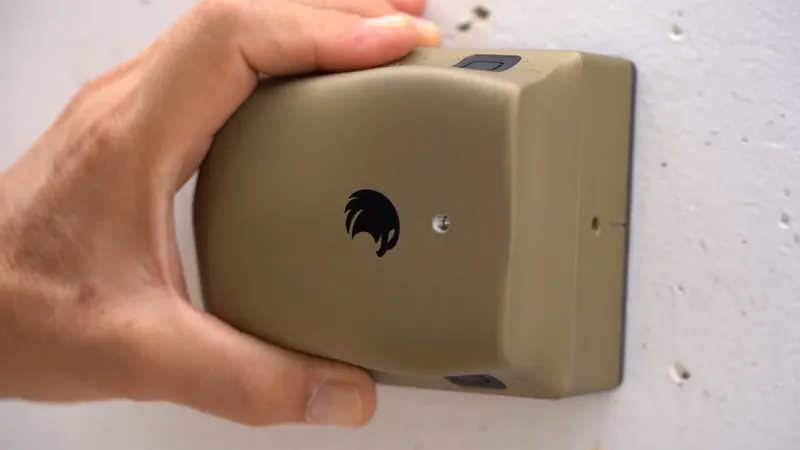
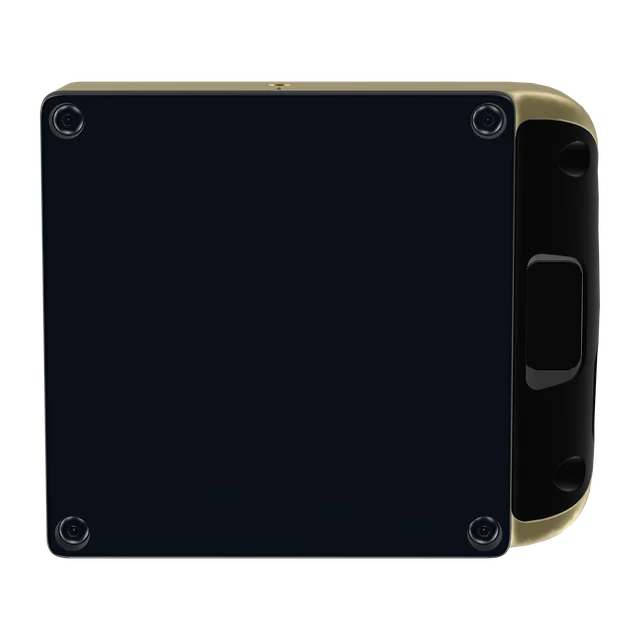
This side goes flat on the surface.
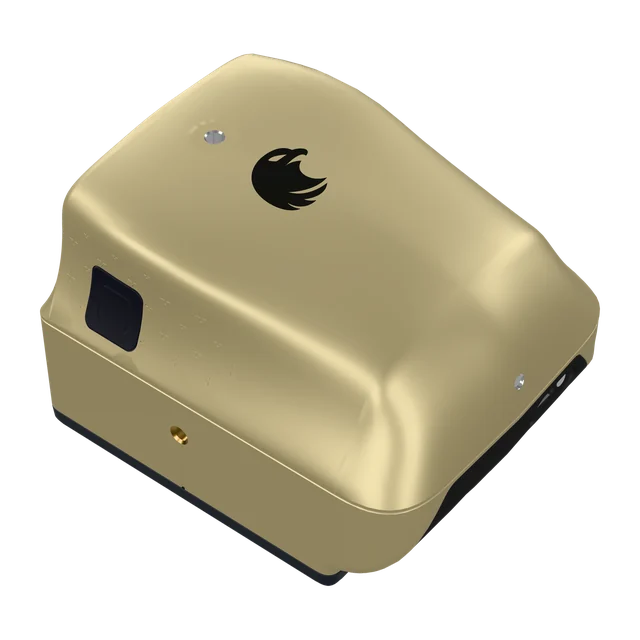
Want to see inside before the next hole?
Eagle XR is a pocket concrete scanner that pairs with your phone and shows rebar, cables, plastic pipes and air voids at their depth. Stated depth in concrete: up to 40 cm. CHF 3,950 excluding VAT, import taxes and delivery.
Buy in Solar GoldPartner link: we may earn a commission. You pay Screening Eagle's normal price.
- Sold and shipped by Screening Eagle
- Same price in all four finishes
- Card, Apple Pay or Google Pay
- Express shipping from Switzerland. US orders ship from Pennsylvania
Sources
- Electrical Safety First, What to do if you believe someone has had, or is getting, an electric shock, read 17 November 2026, electricalsafetyfirst.org.uk
- Electrical Safety First, Advice for DIY-ers, read 17 November 2026, www.electricalsafetyfirst.org.uk
- UK Health and Safety Executive, Work near electricity, read 17 November 2026, www.hse.gov.uk
- Electrical Safety First, RCDs explained, read 17 November 2026, electricalsafetyfirst.org.uk
- US Consumer Product Safety Commission, CPSC Fact Sheet: What is a GFCI? (publication 099), read 17 November 2026, www.cpsc.gov
- NICEIC in Professional Electrician, Why contractors need to apply due diligence when installing cables embedded in thin walls or partitions (BS 7671 Regulations 522.6.202 to 522.6.204), 14 August 2023, read 17 November 2026, professional-electrician.com
- Thames Water, Frozen or burst pipes, read 17 November 2026, www.thameswater.co.uk
- WaterSafe, What should I do if a pipe bursts?, read 17 November 2026, watersafe.org.uk
- City of Bellevue (Washington) Utilities, Prevent frozen pipes, and what to do if one breaks, read 17 November 2026, bellevuewa.gov
- SGN (gas network operator), What to do if you smell gas, read 17 November 2026, sgn.co.uk
- PG&E (Pacific Gas and Electric), Gas safety, read 17 November 2026, www.pge.com
- Warmup, 5 wet underfloor heating FAQs answered, 13 March 2023, read 17 November 2026, www.warmup.co.uk
- Wunda (UK), 16 mm nut and insert and repair coupling instructions T03, 2018, read 17 November 2026, www.wundagroup.com
- Apple App Store, Eagle XR listing by Screening Eagle Technologies AG, read 17 November 2026, apps.apple.com
- Screening Eagle, Eagle XR product page and FAQ, read 17 November 2026, xr.screeningeagle.com