X-ray concrete scanning: X-ray, GPR or a pocket scanner?
Many firms and buyers say "X-ray" for radar scanning as well as for real radiography. They are different jobs, with different access, safety rules and prices.
Before you book a concrete X-ray
Stop and call a scanning firm if
- the slab is poured on the ground, with no floor below
- the job is a core, a saw cut or a post-tensioned slab
The short version of this page. The details and sources follow below.
From X-ray concrete scanning: X-ray, GPR or a pocket scanner?: drillclear.com/guides/x-ray-concrete-scanning, where every step has its sources.
The short answer
Real concrete X-ray is radiography, a different job from the radar scanning that some firms also call X-ray. Radiography needs both sides, a cleared area and licensed operators. GPR (ground penetrating radar) reads radio-wave echoes from one side. A pocket scanner such as Eagle XR is neither.
What real concrete X-ray is
Concrete X-ray sends X-rays or gamma rays through the concrete onto a film or detector on the far side. The International Atomic Energy Agency (IAEA) guidebook on testing concrete explains it: the beam loses intensity as it passes through material, and the beam that comes out exposes a film. Where the concrete is thin, or there is a void, more radiation gets through and the film is darker2.
Applied Technical Services (ATS), a testing firm, X-rays slabs, columns, beams and floors on site. The film records the differences in absorption and can serve as a permanent record3. Acuren, another testing firm, also offers computed radiography and digital radiography. It says digital radiography is fastest, gives the highest resolution, and suits thinner concrete of 8 to 10 inches4.
There are two kinds of source. An X-ray tube runs on electricity and can be switched on and off. A gamma source is a radioactive isotope, such as iridium-192 or cobalt-60, and cannot be switched off2.
The IAEA says radiography can locate bars, estimate their diameter and depth, and reveal voids, cracks, foreign materials and whether post-tensioning ducts are grouted2. ATS lists rebar, pipes, conduits, cables and wire mesh, plus cracks, corrosion, voids and honeycombing3.
Both sides, or nothing
X-ray needs both faces, and a slab poured on the ground has no floor below. ATS says site X-ray needs access to both sides: for a floor, the test floor and the floor below it3. The IAEA adds that in many structures the method cannot be used because the film cannot be placed in a suitable position2.
Thickness also limits it. The IAEA quotes these ranges from BS 1881-205: iridium-192 for about 25 to 250 mm of concrete, cobalt-60 for 125 to 500 mm, and an 18 MeV linear accelerator for 500 to 1,600 mm2. BSI lists BS 1881-205:1986 as withdrawn on 21 April 20115.
Radiation safety and licences
Site radiography needs a controlled area cleared of everyone but authorised staff, and licensed operators. The IAEA says the boundary is set at a dose rate the regulator authorises and marked out with warning notices, and that gamma radiography "must be operated by trained and licensed personnel", isolated from the public2.
In Great Britain, industrial radiography needs consent from the Health and Safety Executive6. One condition of that consent is that the firm receives at least seven days' written notice from its client before each site radiography job, unless HSE agrees in writing to waive it7.
How far the zone reaches depends on the source and the job, and firms quote their own figures. Nova Advanced Imaging, an X-ray firm in Vancouver and Toronto, gives up to 45 ft for its X-ray tube and up to 300 ft for gamma sources8. Util-Locate, a US locating firm, gives a 50-foot minimum and says X-ray usually means off-hours work in occupied buildings9. The radiography firm sets the zone for your site under its licence, and everyone else stays out.
Why GPR gets called X-ray
Many people say X-ray for any look inside concrete, and some firms do too. One GPR firm's page says: "Concrete scanning is X-ray vision for your slab"10. Nova warns that some companies rebrand radar as X-ray8.
The IAEA describes GPR as radio waves sent into the material, part of which reflect back where the material changes. It can survey large areas quickly. Its limits: features screened by steel bars are not recorded, and small deep targets are harder to see2. For depths and how a scan reads, see GPR, wall detector or pocket scanner and how to read a concrete scan.
Side by side
The three compare like this on access, safety, time, result and depth.
| Radiography (X-ray or gamma) | GPR | Eagle XR | |
|---|---|---|---|
| What goes in | X-rays or gamma rays2 | Radio waves2 | EM waves16 |
| Access | Both sides3 | One side9 | The surface you scan1 |
| Safety | Cleared controlled area, licensed staff2 | No exclusion zone4 | No zone mentioned on its pages1 |
| Time | Long exposures, heavy kit2 | About 15 minutes a location, one firm says10 | Real time1 |
| Result | Film or digital image, a record3 | Echoes read by a trained operator2 | Colour image on your phone1 |
| Depth | About 250 mm iridium, 500 mm cobalt2 | Top 12 to 18 inches, one firm says10 | 40 cm stated1 |
| Typical use | Before coring3 | Cores, cuts, PT slabs, mapping10 | A first look before a hole1 |
What it costs
Radiography firms quote per job, and the ones we read publish no price. Those were ATS, Acuren and Nova348. The IAEA says exposures are long, so the cost of radiography can be high2. Util-Locate, a firm that sells GPR scanning, says X-ray services are often up to 10 times more expensive than GPR scanning9. That is a competitor's view, not a price.
GPR firms do publish figures. All of these were read on 16 November 2026:
- Rush Locates, Portland: $200 per hour, with a 2 hour minimum11.
- Arcbound Logic, Cleveland: typically $175 per hour, with a two-hour minimum often appropriate12.
- RainierGPR, Washington and Florida: most concrete scanning jobs run $650 to $1,75010.
- SPH Engineering, in its 2026 cost article: a market estimate of about $1,000 to $3,000 per day, which it calls planning ranges only13.
- Trade2Base, a UK blog for trades, dated 8 June 2026: GPR scanning typically £150 to £400 per visit14.
Prices move: get a written quote.
Is "Eagle X-ray" an X-ray?
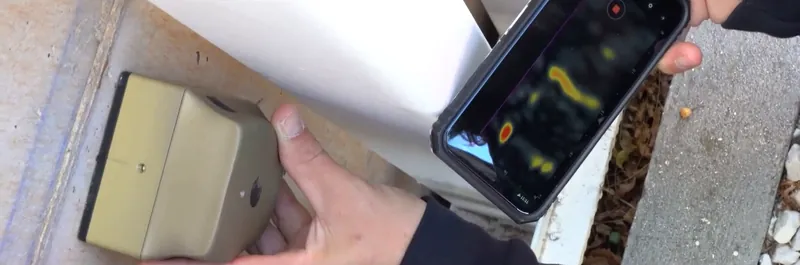
No: Eagle XR reads reflections from the face you scan, and XR stands for Xtended Reality. Screening Eagle's home page spells it out15. It says the scanner sends electromagnetic waves into the concrete, and Eagle Intelligence turns the reflections into a clear colour image on your phone1. Its press release calls this EM-wave imaging16. That is not a beam through to a film on the far side, and none of the pages we read mentions a radiation zone, a licence or a film116.
It is not a GPR either. Screening Eagle's FAQ calls it a first look for everyday work, so you know whether a wall, slab or column is clear or whether to call an expert, and says professionals use GPR systems such as Proceq's for investigations, mapping and reports1. Where a job calls for an X-ray or GPR survey, Eagle XR does not replace it. See the Eagle XR fact sheet, the scanner comparison and Eagle XR or Proceq GPR.
Which to ask for
A first look for small holes, a scanning firm for cores, and X-ray only when both faces can be reached.
- An anchor or a small hole: drawings, the power off, and a first look with a scanner. See how to drill into concrete safely.
- A core, a saw cut or a post-tensioned slab: a scanning firm, under the building's procedure. Read drilling into a post-tensioned slab.
- X-ray: when the area can also be cleared and the detail is worth the wait. Util-Locate names crowded slabs and structural checks as cases9.
- A survey "to standard": see concrete scanning standards.
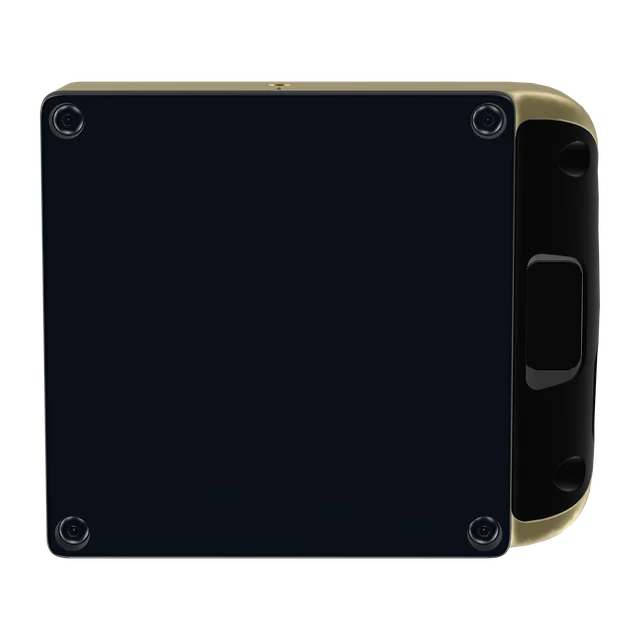
This side goes flat on the surface.
Want to see inside before the next hole?
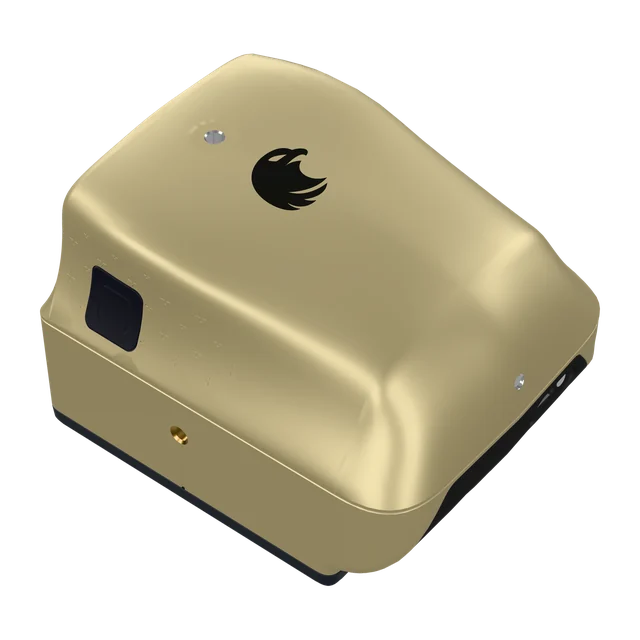
Eagle XR is a pocket concrete scanner that pairs with your phone and shows rebar, cables, plastic pipes and air voids at their depth. Stated depth in concrete: up to 40 cm. CHF 3,950 excluding VAT, import taxes and delivery.
Buy in Solar GoldPartner link: we may earn a commission. You pay Screening Eagle's normal price.
- Sold and shipped by Screening Eagle
- Same price in all four finishes
- Card, Apple Pay or Google Pay
- Express shipping from Switzerland. US orders ship from Pennsylvania
Sources
- Screening Eagle, Eagle XR product page and FAQ, read 16 November 2026, xr.screeningeagle.com
- IAEA, Guidebook on non-destructive testing of concrete structures, Training Course Series No. 17 (2002), sections 1 and 10, read 16 November 2026, www-pub.iaea.org
- Applied Technical Services (ATS), Concrete X-Ray Services, read 16 November 2026, atslab.com
- Acuren, Why Advanced Radiography is the Best Choice for Concrete Imaging, 4 March 2025, read 16 November 2026, www.acuren.com
- BSI Knowledge, BS 1881-205:1986 Testing concrete. Recommendations for radiography of concrete, status page, read 16 November 2026, knowledge.bsigroup.com
- UK Health and Safety Executive, Work with ionising radiation that requires consent, read 16 November 2026, www.hse.gov.uk
- UK Health and Safety Executive, Operations Notice 34, Ionising Radiations Regulations 2017: notification of offshore site radiography work, revised 6 January 2023, read 16 November 2026, www.hse.gov.uk
- Nova Advanced Imaging, Concrete X-Ray: What is Fake and True X-Ray, read 16 November 2026, www.xraynova.com
- Util-Locate, GPR vs X-Ray Scanning for Concrete Imaging: Which Is Better, 16 June 2026, read 16 November 2026, www.util-locate.com
- RainierGPR, Concrete Scanning, service page and FAQ, read 16 November 2026, rainiergpr.com
- Rush Locates, Concrete Scan with Ground Penetrating Radar (GPR), read 16 November 2026, www.rushlocates.com
- Arcbound Logic, Concrete GPR Scanning Cleveland and Northeast Ohio, read 16 November 2026, arcboundlogic.com
- SPH Engineering, Ground Penetrating Radar Price and GPR Survey Cost (2026), read 16 November 2026, www.sphengineering.com
- Trade2Base blog, Concrete Cutting and Drilling Pricing UK, 8 June 2026, read 16 November 2026, www.trade2base.com
- Screening Eagle, home page and FAQ, read 16 November 2026, www.screeningeagle.com
- Screening Eagle, Eagle XR launch press release, 17 September 2026, read 16 November 2026, www.screeningeagle.com