Do stud finders work on concrete? Can they find rebar?
Most stud finders are built for drywall over timber or steel studs. Here is what each kind of tool can do on concrete, by its maker's own figures.
Before you trust a stud finder on concrete
Stop and call a scanning firm if
- the slab is, or might be, post-tensioned
- the job is a structural core or a saw cut
The short version of this page. The details and sources follow below.
From Do stud finders work on concrete? Can they find rebar?: drillclear.com/guides/stud-finder-on-concrete, where every step has its sources.
The short answer
No: a normal stud finder does not work on concrete, and a metal mode only finds metal near the surface. To see rebar, cables and plastic pipes at their depth you need a radar-type scanner, or a scanning firm.
How a stud finder works, and why concrete defeats it
A stud finder senses changes in density behind a thin wall, and its makers rule out solid concrete. A drywall wall is a thin board with air behind it, and a stud is a denser strip in that air. The tool calibrates on the board and signals when the density changes. Zircon's StudSensor BASIC finds the edges of wood and metal studs up to 19 mm behind the surface, and is not designed for glass or other dense materials, or for surfaces thicker than 19 mm. Zircon also notes that studs are normally 40 or 60 cm apart and 38 mm wide, and that anything else may not be a stud1. Our guide to drywall, brick and block covers cable zones and stud spacing.
Solid concrete has no thin board over a hollow to calibrate on, and no studs: what matters is what was cast in, such as bars, conduits, pipes and sometimes tendons. Zircon's L70 cannot scan for wood studs and joists through concrete2. Stanley says its Stud Sensor 150 cannot scan through cement or concrete, and that the thickness, density and moisture of the surface material affect the sensing depth3. Its Stud Sensor 300 "will not detect objects in concrete, mortar, block or brick work"4.
Do stud finders only find wood?
No: none of the three common kinds senses wood as such. They look for density changes, for metal, or for several things at once.
- Density stud finders react to changes in density1. Zircon warns that other objects can be detected, especially very close to the wall: "Do not assume everything detected is a stud"1.
- Magnetic stud finders do not sense wood at all. Kreg says its magnetic stud finders are designed to find the screws and nails in steel and wood studs5.
- Multi-detectors look for several things. Bosch says the GMS 120-27 detects metal such as reinforcing steel, wooden beams and live wires, and warns that with the wood function on, water-filled plastic pipes, power cables or gas lines may show up as non-metallic objects6.
Can a stud finder detect rebar?
A density mode cannot, but a metal mode can find a bar near the surface.
| Tool | What the maker states |
|---|---|
| Bosch GMS 120-27 Multi-detector | 100 mm for 12 mm reinforcing steel, 120 mm for a 15 mm copper pipe, 50 mm for live wires. Depth depends on the material and size of the objects, and on the material and condition of the substrate6 |
| Bosch Truvo Home detector | Metal up to 70 mm, live cables up to 50 mm7 |
| Zircon MetalliScanner MT 6 Metal detector | Shows no metal icon until metal is less than 15 cm deep. Depth readings are tuned for 13 mm copper pipe or #4 rebar8 |
Rebar brings its own problem. Zircon's manual says: "If a grid pattern exists, such as may occur with rebar in concrete, there may be no area free of metal"8. Bosch asks you to move the GMS 120-27 in a circle more than 30 cm across before you measure, so it can first detect the steel mesh6. Zircon adds that concrete should be fully cured for best accuracy, and that slabs poured at different times need a fresh calibration for each segment8.
A metal mode finds only metal. Zircon says the MT 6 cannot locate nonmetallic objects such as wood studs or PVC pipe8, and Stanley says the Stud Sensor 300 is not designed to find non-ferrous or plastic objects such as pipes4. Do not expect it to show a bar deeper than the stated depth.
Live cables are harder. Zircon warns that its live wire sensing may miss wires more than 51 mm from the surface, in concrete or in conduit2. Bosch says three-phase cables cannot be detected as live, because the phases cancel out6. The UK Health and Safety Executive adds that some cable detectors will not find a wire carrying a small current9.
Can I use my phone as a stud detector?
Not on its own: a phone's magnetometer only measures a magnetic field. Android's developer guide says this sensor measures the geomagnetic field on all three physical axes10, and Apple describes its magnetometer data as measurements of the Earth's magnetic field relative to the device11. Neither page presents it as a way to find things in walls, or gives a range.
A magnetometer app at best behaves like a magnetic stud finder, which finds screws and nails5. Wood and plastic are not magnetic, and Zircon's manual treats copper as a non-magnetic metal8, so a field reading tells you nothing about them. On concrete it may react to steel close to the surface. Do not drill on it.
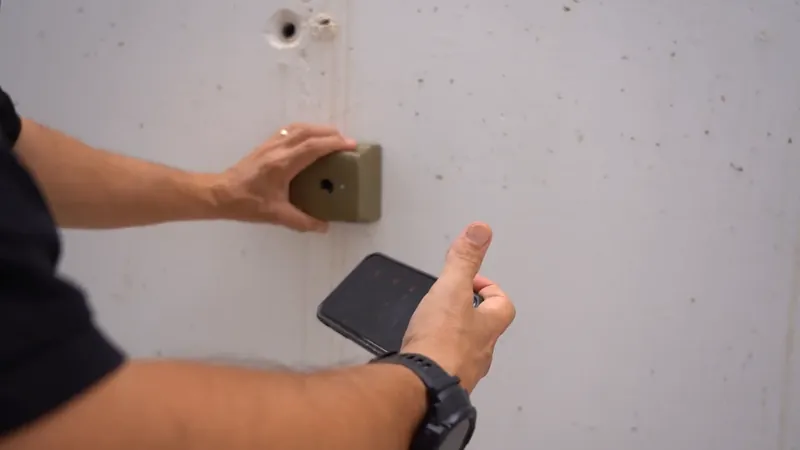
Some phone tools add their own sensor. The Walabot DIY 2 M is a radar add-on for drywall and plywood, and its maker says: "Do NOT use on lath and plaster, concrete, tiles, bricks"12. Eagle XR is a concrete scanner that pairs with your phone13. In both cases the phone is the display, not the sensor. The two are compared on Eagle XR vs Walabot DIY 2.
Radar wall scanners and pocket scanners
Radar-type tools also see things that are not metal. Bosch lists water-filled plastic pipes, wood, metal and live cables for its D-tect 120, up to 120 mm, with a concrete setting14. For the D-tect 200 C it states 200 mm in dry concrete, 60 mm in early age concrete, and empty plastic pipes too15.
Screening Eagle says Eagle XR shows rebar, cables, plastic pipes and even air voids in colour at their depth, plus the back of the element, and gives 40 cm as its depth in concrete13. It also says Eagle XR is not a GPR but "a first look for everyday work"13. Its App Store listing names concrete (dry, normal or wet), drywall and masonry (brick and block)16, and the product page says Eagle Intelligence is trained on concrete and learning more materials13. See the Eagle XR fact sheet, and the scanner comparison for every tool's stated depth drawn to scale.
Which one for which job
Stud finders suit stud walls; concrete needs a radar-type scanner or a scanning firm.
| Job | Tool that fits |
|---|---|
| Shelf or TV bracket on a stud wall | Density stud finder, or a magnetic finder for the screws |
| Checking drywall for a live cable | Detector with a live wire mode, then switch the power off before drilling |
| Anchor in a concrete wall or ceiling | Radar wall scanner or pocket scanner. A metal mode only finds shallow metal, not plastic |
| Plastic pipes or underfloor heating | Radar-type scanner. Metal detectors cannot find plastic |
| Core, saw cut or post-tensioned slab | Scanning firm with GPR, under the building's procedure |
The longer version, with cover meters and GPR, is in GPR, wall detector or pocket scanner.
Before you drill, whatever the tool
The routine is the same for every tool: drawings, supply off, a scan across and another at 90 degrees. Zircon says not to rely on the tool alone but to use construction plans, standard spacing and visible points where pipes and wiring enter walls, and to turn off electrical, gas and water supplies before you go through a surface1. The HSE says to ask for plans of the electrical installation and look on both sides of walls9: "If unsure where concealed cables are, turn the electricity supply off before drilling into walls etc."17.
Bosch says to do a cross measurement if you do not know which way an object runs6, and Zircon to scan again perpendicular to the first pass8. Bosch also warns there may be a hazard even when the tool shows no object6. For the specialist jobs, read drilling into a post-tensioned slab and use the core drilling checklist.
If you do hit something, read you hit rebar while drilling. People who say X-ray when they mean a scan will find the difference in X-ray concrete scanning.
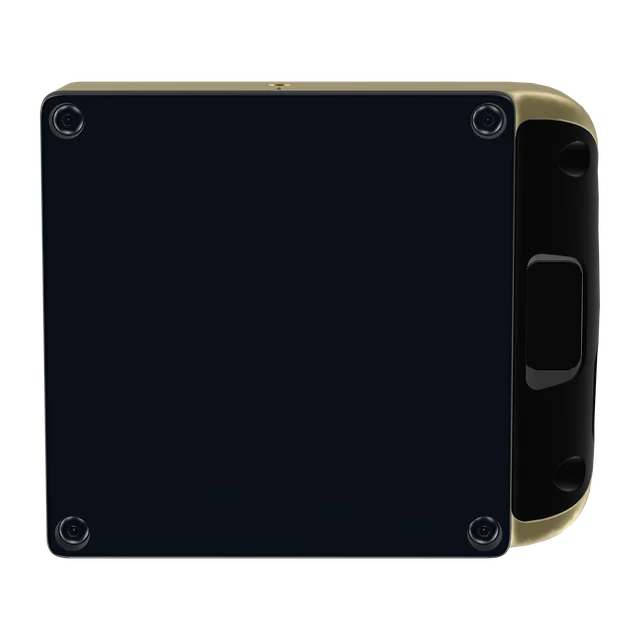
This side goes flat on the surface.
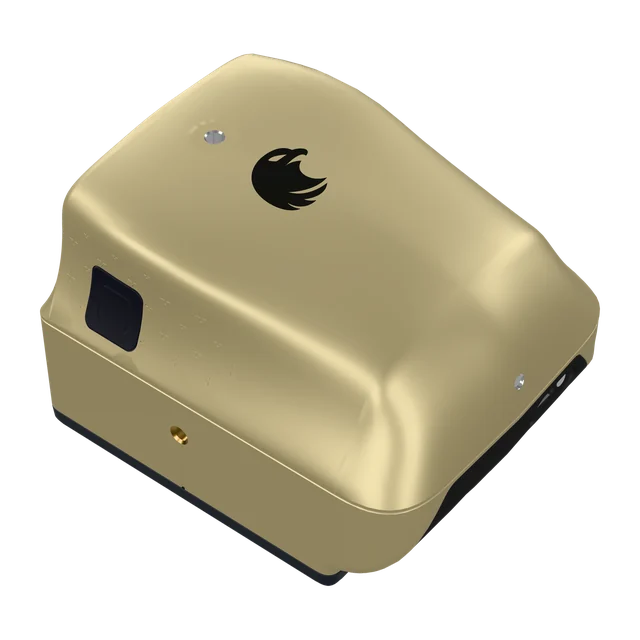
Want to see inside before the next hole?
Eagle XR is a pocket concrete scanner that pairs with your phone and shows rebar, cables, plastic pipes and air voids at their depth. Stated depth in concrete: up to 40 cm. CHF 3,950 excluding VAT, import taxes and delivery.
Buy in Solar GoldPartner link: we may earn a commission. You pay Screening Eagle's normal price.
- Sold and shipped by Screening Eagle
- Same price in all four finishes
- Card, Apple Pay or Google Pay
- Express shipping from Switzerland. US orders ship from Pennsylvania
Sources
- Zircon, StudSensor BASIC edge-finding stud finder, instruction manual, read 16 November 2026, www.zircon.com
- Zircon, StudSensor L70 OneStep instructions, copy hosted by Farnell, read 16 November 2026, www.farnell.com
- Stanley, Stud Sensor 150 instructions (2012), copy hosted by Farnell, read 16 November 2026, www.farnell.com
- Stanley, Stud Sensor 300 instructions, copy hosted by Tremtech, read 16 November 2026, store.tremtech.com
- Kreg Tool, Magnetic Stud Finder KMM1000, product page and questions, read 16 November 2026, www.kregtool.com
- Bosch, GMS 120-27 Professional, original instructions 1 609 92A 9PR (2024.07), English section, read 16 November 2026, www.bosch-professional.com
- Bosch DIY (UK), Truvo digital detector 0603681205, product page and technical specifications, read 16 November 2026, www.bosch-diy.com
- Zircon, MetalliScanner MT 6 instructions, P/N 58932 Rev D 10/21, read 16 November 2026, sp.zircon.com
- UK Health and Safety Executive, Work near electricity, read 16 November 2026, www.hse.gov.uk
- Android Developers, Sensors overview (TYPE_MAGNETIC_FIELD), read 16 November 2026, developer.android.com
- Apple Developer Documentation, Core Motion, CMMagnetometerData, read 16 November 2026, developer.apple.com
- Walabot (Vayyar), Walabot DIY 2 M product page, read 16 November 2026, walabot.com
- Screening Eagle, Eagle XR product page and FAQ, read 16 November 2026, xr.screeningeagle.com
- Bosch Professional (UK), D-tect 120 wallscanner, product page and technical data, read 16 November 2026, www.bosch-professional.com
- Bosch Professional (UK), D-tect 200 C wallscanner, product page and technical data, read 16 November 2026, www.bosch-professional.com
- Apple App Store, Eagle XR listing by Screening Eagle Technologies AG, read 16 November 2026, apps.apple.com
- UK Health and Safety Executive, CIS65 Avoiding concealed services and overhead power lines, read 16 November 2026, www.hse.gov.uk