Drilling into drywall, brick and block: what is behind it and how to check
A hollow wall has less material in it and room for services. Here is what usually sits behind the board or the brick, what the wiring rules say about cable routes, and how far to trust them.
Before you drill into drywall, brick or block
Stop and call a competent person (an electrician, or the lintel maker for a lintel) if
- you are not sure the circuit is dead
- the wall was built before 2000 and could contain asbestos
- the fixing goes into a prestressed lintel and you cannot locate its tendons
The short version of this page. The details and sources follow below.
From Drilling into drywall, brick and block: what is behind it and how to check: drillclear.com/guides/drywall-and-masonry, where every step has its sources.
Stud walls: what is behind the board
Behind the board is a frame of studs at set spacings, with a hollow cavity between them.
- Studs, US. The International Residential Code's stud table, as adopted in California, caps wood stud spacing at 16 or 24 in on centre, depending on stud size and what the wall carries1. Stud finder maker Zircon gives the same spacings (40 or 60 cm) and a stud width of 1 1/2 in (38 mm)2.
- Studs, UK. voestalpine Metsec sets its standard metal stud partitions at 600 mm centres, 400 mm where the wall is tiled3.
- The cavity. Cables, water pipes, gas lines and firestops are all commonly found in it2.
Where cables are supposed to run
Each country's wiring rules set cable zones or clearances, and they differ.
| Region and rule | What it says |
|---|---|
| UK BS 7671, Regulation 522.6.202 | A cable less than 50 mm below the surface, without earthed metal or mechanical protection, has to run in a zone: within 150 mm of the top of the wall, within 150 mm of a corner between two walls, or horizontally or vertically in line with a socket, switch or other accessory on the wall45. Where the wall is 100 mm thick or less and the accessory's position can be worked out from the other side, the zone counts on that side too5. In metal-framed partitions further protection applies at any depth (522.6.203)4. |
| US NEC 300.4, 2023 edition | Where a cable passes through a bored hole in wood framing, the edge of the hole must be at least 1 1/4 in from the nearest edge of the wood, or the cable is protected by a steel plate at least 1/16 in thick. The same clearance applies where it runs parallel to framing6. In the 2026 edition the section becomes 300.66. |
| Germany DIN 18015-3, homes | Horizontal zones 15 to 45 cm below the ceiling and 15 to 45 cm above the finished floor. Vertical zones 10 to 30 cm beside door and window openings and wall corners. A middle zone 100 to 130 cm above the floor in rooms with worktops7. |
The IET quotes the UK text from the 17th Edition, where it was 522.6.6; NICEIC gives the same zones under today's number45. The German figures are a trade journal's summary of the 2007 edition7. Check the current text before you rely on any of them.
The US rule sets a clearance from the face of the framing, not a route across the wall. Pipes have a similar US rule: under the International Residential Code as adopted in South Carolina, a pipe other than cast iron or galvanized steel that passes through a stud less than 1 1/4 in from its edge needs a steel shield plate8.
Brick and block
In brick and block, watch for three things: hollow units, chases and lintels.
- Hollow block. US concrete masonry units typically have a nominal face of 8 by 16 in and nominal thicknesses from 4 to 16 in, and ASTM C90 sets minimum face shell and web thicknesses for hollow units9. Your bit usually goes through a shell into a void. For Porotherm clay blocks, fischer's test report says to drill on rotary only, without hammer action10.
- Chases. Cables and pipes in masonry usually lie in chases cut into the face. In England, Approved Document A limits them to one third of the wall or leaf thickness if vertical and one sixth if horizontal, and warns about stability, particularly where hollow blocks are used11.
- Lintels. The beam over a door or window is longer than the opening: UK maker Naylor supplies lintels with an end bearing of 100 mm for openings up to 1,000 mm, 150 mm up to 3,000 mm and 200 mm beyond12. For its prestressed concrete lintels, Naylor's engineers rule out holes for chemical anchors and add: "Plugging and drilling is acceptable providing that the location of prestressing tendons is not compromised"12. You cannot see the tendons from the front, so scan first or ask the maker.
Which tool for which wall
Match the detector to the wall, and know its maker's limits.
| Tool | What its maker states | Limits its maker states |
|---|---|---|
| Stud finder Zircon StudSensor HD55 | Stud edges through up to 3/4 in (19 mm) of board, 1 1/2 in (38 mm) in deep mode, plus an alert for live, unshielded AC wiring2 | Not recommended on lath and plaster. Wires deeper than 2 in (50 mm) or in metal conduit may not be detected2. |
| Multi-detector Bosch GMS 120 | Magnetic metal to 120 mm, non-magnetic metal to 80 mm, live cables to 50 mm, wooden substructures to 38 mm13 | Plastic pipes are not on its list13 |
| Radar wall scanner Bosch D-tect 200 C | Separate wall types for drywall, brick, vertically and horizontally perforated brick and concrete14 | In drywall mode a filled plastic pipe and a wooden beam look identical and empty plastic pipes are not recognised. In horizontally perforated brick the maximum depth is 5 cm14. |
We compare tool types for concrete in GPR, wall detector or pocket scanner.
Checking for live cables
A detector that stays silent has not proved the wall is dead. The UK Health and Safety Executive warns that some cable detectors will not find a wire carrying a small current15. Bosch's manual adds that three-phase wiring may not be detected as live, and that live detection may be limited above 50% relative humidity14.
HSE says to look on both sides of the wall for where wiring runs to nearby sockets, switches and equipment15, and to turn the supply off before drilling when you are unsure where cables are16. A competent person then proves it dead, with voltage test equipment that works and is reliable, by checking that the circuit is no longer live15.
On US construction sites, finding out is the employer's legal duty. OSHA requires the employer to find out "by inquiry or direct observation, or by instruments" whether any energized circuit, exposed or concealed, could be contacted by a person or tool17.
Older buildings. Asbestos was banned in Great Britain in 1999, and HSE says buildings constructed after 2000 are unlikely to contain it20. Before that it was used in partition boards and textured wall and ceiling coatings21. If the wall could contain it, check before you drill.
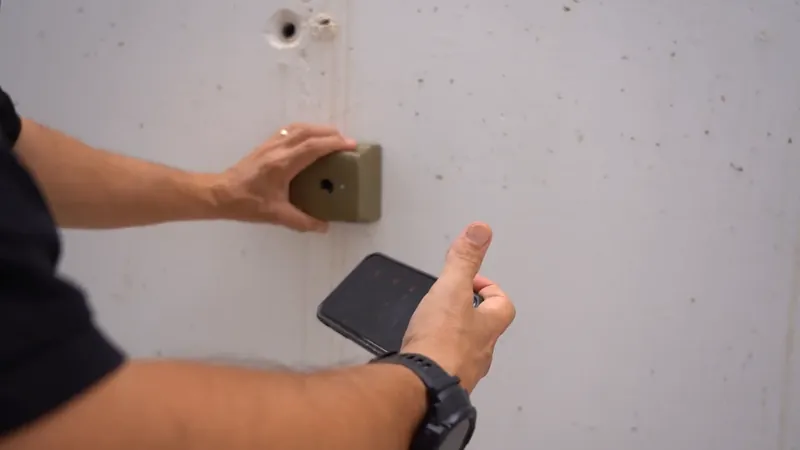
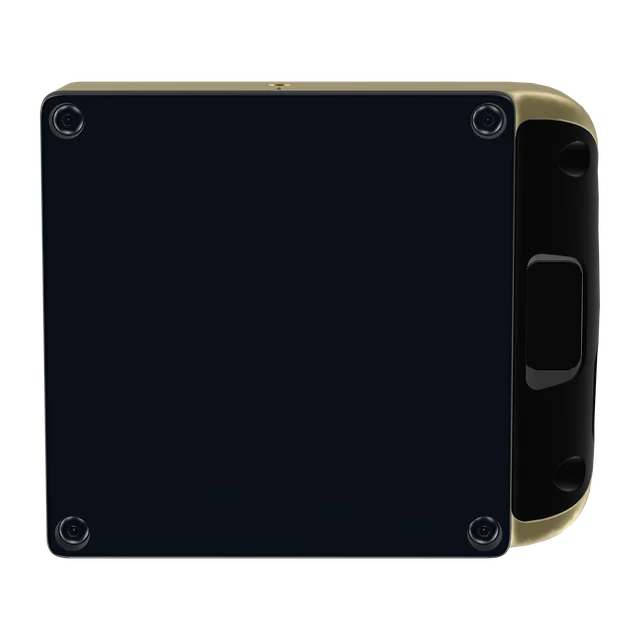
This side goes flat on the surface.
Where Eagle XR fits
The App Store listing covers drywall and masonry, but Eagle XR's only published depth figure is for concrete. The listing names concrete ("dry, normal or wet"), drywall, and masonry (brick and block)18. The product page states the 40 cm figure for concrete, and says Eagle Intelligence is trained on concrete and learning more materials19. No depth or accuracy figure for drywall or masonry is published.
It scans one line at a time, in one direction, so a stud wall needs a horizontal line to cross studs and vertical runs, and a vertical line to catch horizontal runs. See how to use Eagle XR and, for pipes, how to find plastic pipes.
Limits
Rules and maker figures tell you where to look first, not what is there.
- Code rules describe compliant work in one country. Old, altered or DIY wiring may not follow them.
- Maker figures are stated maximums. Makers themselves list what throws their tools off: foil-laminated insulation, metal building materials, moisture, lath and plaster214.
- Nothing on this page replaces isolation, or an electrician where one is required.
Want to see inside before the next hole?
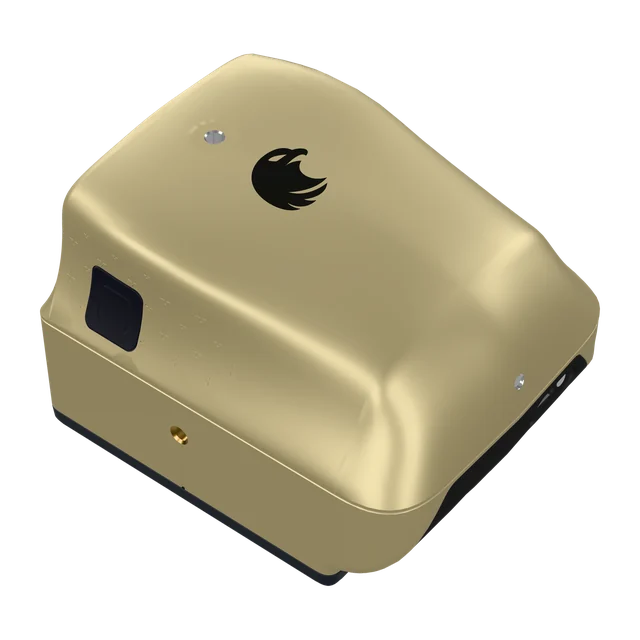
Eagle XR is a pocket concrete scanner that pairs with your phone and shows rebar, cables, plastic pipes and air voids at their depth. Stated depth in concrete: up to 40 cm. CHF 3,950 excluding VAT, import taxes and delivery.
Buy in Solar GoldPartner link: we may earn a commission. You pay Screening Eagle's normal price.
- Sold and shipped by Screening Eagle
- Same price in all four finishes
- Card, Apple Pay or Google Pay
- Express shipping from Switzerland. US orders ship from Pennsylvania
Sources
- International Residential Code Table R602.3(5), as adopted in the 2025 California Residential Code, gocodebook.com
- Zircon, StudSensor HD55 instructions, cdn.aws.toolstation.com
- voestalpine Metsec (UK), Standard non load bearing partitions: installation, www.metsec.com
- NICEIC in Professional Electrician, Cables embedded in thin walls or partitions (BS 7671 Regulations 522.6.202 to 522.6.204), 2023, professional-electrician.com
- Geoff Cronshaw, IET Wiring Matters, Requirements for cables concealed in a wall or partition, 2008, content.voltimum.com
- Vince LaPorta, IAEI Magazine, NEC 300.4 Protection against physical damage, 2026, iaeimagazine.org
- Werner Baade, de (das elektrohandwerk) 21/2007, DIN 18015-3:2007-09 Leitungsführung und Anordnung der Betriebsmittel, elektro.net
- International Residential Code P2603.2.1, as adopted in South Carolina (S.C. Code Regs. 8-1240), www.law.cornell.edu
- Concrete Masonry and Hardscapes Association, CMU-TEC-001 Concrete masonry unit shapes, sizes, properties and specifications, www.cmha.org
- fischer, Fixing tests for Wienerberger Porotherm blocks, test report, www.wienerberger.co.uk
- HM Government (England), Approved Document A: Structure, 2013 reprint, paragraph 2C30, assets.publishing.service.gov.uk
- Naylor (UK), Concrete lintels brochure: installation, end bearing and cutting, checkout.mkm.com
- Bosch, GMS 120 data sheet, static.chipdip.ru
- Bosch, Wallscanner D-tect 200 C Professional, original instructions (European edition, 2022), www.bosch-professional.com
- UK Health and Safety Executive, Work near electricity, www.hse.gov.uk
- UK Health and Safety Executive, CIS65 Avoiding concealed services and overhead power lines, www.hse.gov.uk
- US Occupational Safety and Health Administration, 29 CFR 1926.416(a)(3), text at Cornell Legal Information Institute, www.law.cornell.edu
- Apple App Store, Eagle XR listing by Screening Eagle Technologies AG, read 15 November 2026, apps.apple.com
- Screening Eagle, Eagle XR product page and FAQ, read 15 and 16 November 2026, xr.screeningeagle.com
- UK Health and Safety Executive, Introduction to asbestos safety, www.hse.gov.uk
- UK Health and Safety Executive, Locations of asbestos and taking the right action, www.hse.gov.uk