How to find plastic pipes and underfloor heating before you drill
Detecting an all-plastic pipe takes a tool that sees non-metal, or a pipe that gives itself away with heat.
Before you drill near plastic pipes
Stop and call the plumber or the system installer if
- the bit hits a pipe (shut off the water, or the pump and that loop, first)
- a repair would end up buried in screed or concrete
- you cannot place each pipe and are going by a rule of thumb
The short version of this page. The details and sources follow below.
From How to find plastic pipes and underfloor heating before you drill: drillclear.com/guides/finding-plastic-pipes, where every step has its sources.
Why a metal detector misses them
A metal detector looks for metal, and an all-plastic pipe such as PEX, PE-RT or PVC has none. The Bosch GMS 120 data sheet, for example, lists magnetic and non-magnetic metals, live cables and wooden substructures1.
Some heating pipe is multilayer: Wunda's underfloor pipe, for example, is Pert/Alu/Pert13. We found no maker's figure for how well a metal detector picks up that thin aluminium layer, and you rarely know which pipe is in the floor, so do not count on it.
What does find them
Drawings, the manifold, heat and radar can each find plastic pipe, and each has limits.
| Method | How it helps | Watch out for |
|---|---|---|
| Drawings and installer photos | Show loop layout, spacing and the manifold | What was built often differs |
| Manifold tracing | In a manifold system every heating loop starts and ends at the manifold12, so the floor in front of it carries the most pipes | If the loops are labelled, tells you which room a loop serves, not its route |
| Thermal camera | Bosch's advice: let warm water run through the pipe, and a few minutes later the temperature difference shows on the surface. Underfloor heating shows up well, it says5. | Where pipes or coverings are too well insulated the heat may not reach the surface5. |
| Radar wall scanner | The Bosch D-tect 200 C manual lists water-filled plastic pipes from 10 mm diameter and empty pipes from 20 mm in solid material2 | In several wall modes empty plastic pipes are not displayed2 |
| GPR | Can show non-metal targets and estimate their depth | Takes practice to read |
Bosch's North American manual for the same scanner gives larger sizes: 3/4 in for water-filled and 1 in for empty pipes3. Check the manual that came with your tool.
Water-filled versus empty
What is inside the pipe decides how well it shows, because radar barely sees the plastic. GSSI's handbook calls PVC nearly transparent to radar and rates the reflection from water in concrete as strong, from PVC as weak4. Scan while the system is filled, and expect drained pipes and empty conduits to be faint or missing.
How deep and how far apart: floors
In a wet screed system, heating pipes lie on the insulation, under the screed. These are makers' and listing bodies' minimums for new work.
| Where and what | Cover over the pipe | Pipe spacing |
|---|---|---|
| Europe, wet screed, Uponor floor build-ups referring to EN 1264-4 | At least 45 mm of cement screed or 35 mm of anhydrite liquid screed at 2.0 kN/m² load. 70 and 60 mm at 4.0 kN/m²6. | 10, 15, 20, 25 or 30 cm, with 14 to 17 mm pipe7 |
| UK, wet screed | Screed at least 65 mm thick if hand-mixed, 50 mm if liquid910. With a 16 mm pipe at the bottom that leaves about 49 or 34 mm over the pipe (our arithmetic). | 150 to 350 mm10 |
| US, PEX tubing embedded in concrete, ICC-ES listing for Uponor | At least 3/4 in (19.1 mm) of concrete11 | Not given in the listing |
| Dry systems, Uponor Siccus | Pipes sit in panels under a dry screed panel of 25 mm nominal thickness8 | 15, 22.5 or 30 cm8 |
Depth will not save you: the shallowest figures here are 19 to 25 mm, plus the floor finish, so any fixing drilled deeper can reach a pipe. And the gaps are small: at 10 cm spacing with 17 mm pipe there is about 8 cm of clear screed between pipes (our arithmetic).
Pipes in walls
In a masonry wall a chased pipe sits close to the surface, and we found no published zone rule for where water pipes run.
- Masonry, England. Approved Document A limits vertical chases to one third of the wall or leaf thickness and horizontal chases to one sixth14. In a 100 mm leaf that is about 33 mm and 17 mm (our arithmetic), so a chased pipe sits in the first few centimetres.
- Stud walls, US. The International Residential Code, as adopted in South Carolina, requires steel shield plates where a pipe, other than cast iron or galvanized steel, passes through a stud less than 1 1/4 in (31.8 mm) from its edge15. The plate protects the pipe at the stud. Between studs there may be nothing protecting it.
The cable zones in drilling into drywall, brick and block are electrical rules; do not assume pipes follow them.
If you hit one
Stop, and shut the water or the heating loop off first.
- Shut it off. Close the stop valve, or for heating switch off the pump and close that loop at the manifold. Do not try to plug a pressurised pipe through the hole.
- Call the plumber or the system installer. Do not assume a repair can be buried: Wunda says its repair coupling must stay clearly accessible, never buried in screed or concrete13.
- Ask for a pressure test before the floor is closed. New loops are tested before screeding: Warmup's manual calls for 6 bar held for one hour12.
More in you hit rebar while drilling: what now, which also covers cables.
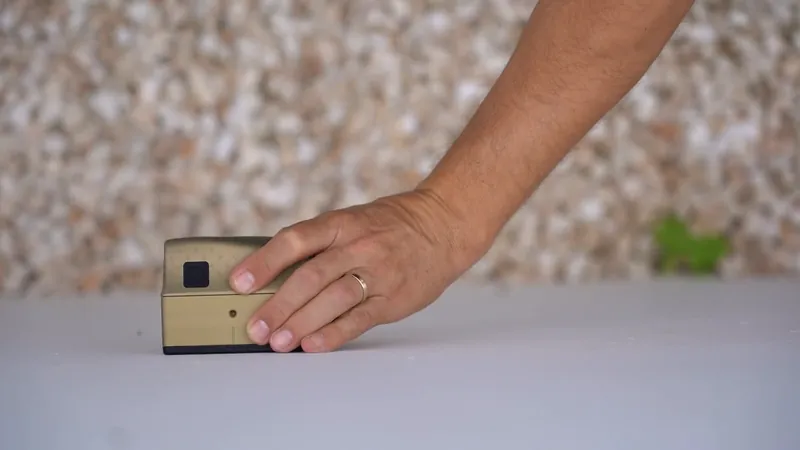
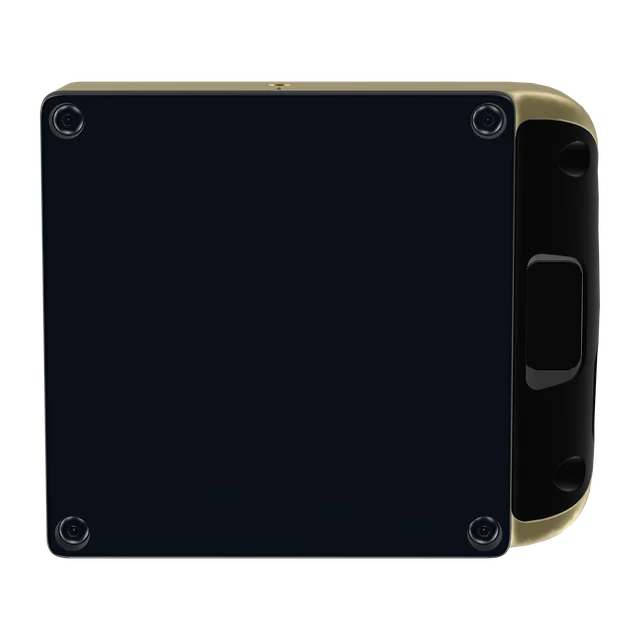
This side goes flat on the surface.
Where Eagle XR fits
Screening Eagle says Eagle XR shows plastic pipes, but not how small a pipe or how accurate the depth. Its App Store listing names water pipes, "even non-metallic PEX and PVC"16. Its product page lists rebar, cables and plastic pipes, shown in colour at their depth, to a stated 40 cm in concrete17. How it does on empty pipes is not published either, and Screening Eagle says Eagle XR is not a GPR and does not replace an expert17.
In our use it scans one line at a time, in one direction: see how to use Eagle XR.
Limits
No single method finds every plastic pipe.
- The floor figures above are for new work from named makers. Thin renovation systems and old floors can differ. Measure, do not assume.
- Gas pipes are outside this guide. The UK Health and Safety Executive's rule covers them too: if you do not know where they are, turn the services off before drilling18.
Want to see inside before the next hole?
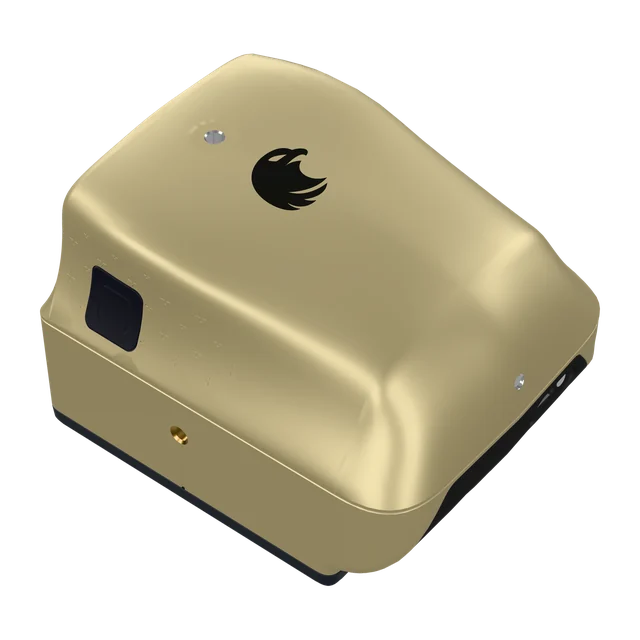
Eagle XR is a pocket concrete scanner that pairs with your phone and shows rebar, cables, plastic pipes and air voids at their depth. Stated depth in concrete: up to 40 cm. CHF 3,950 excluding VAT, import taxes and delivery.
Buy in Solar GoldPartner link: we may earn a commission. You pay Screening Eagle's normal price.
- Sold and shipped by Screening Eagle
- Same price in all four finishes
- Card, Apple Pay or Google Pay
- Express shipping from Switzerland. US orders ship from Pennsylvania
Sources
- Bosch, GMS 120 data sheet, static.chipdip.ru
- Bosch, Wallscanner D-tect 200 C Professional, original instructions (European edition, 2022), www.bosch-professional.com
- Bosch, D-tect 200 C operating instructions (North American edition, 2021), ocsmedia.boschtools.com
- GSSI, Concrete Handbook MN72-367 Rev H, atecorp.com
- Bosch Professional, Thermal measuring tools for interior finishing work, www.bosch-professional.com
- Uponor, Tacker underfloor heating and cooling system, technical information (floor constructions to EN 1264-4), brandportal.uponor.com
- Uponor, Tecto underfloor heating and cooling system, technical information, brandportal.uponor.com
- Uponor, Siccus dry underfloor heating system, technical information, brandportal.uponor.com
- Nu-Heat (UK), Underfloor heating and screed: minimum screed depths, www.nu-heat.co.uk
- Wunda (UK), Solid floor pipe staple system fact sheet F02, 2018, www.wundagroup.com
- ICC Evaluation Service, PMG-1012 listing for Uponor PEX tubing in radiant heating, effective August 2026, icc-es.org
- Warmup (UK), Silva underfloor heating installation manual: pressure testing, www.warmup.co.uk
- Wunda (UK), 16 mm repair coupling instructions T03, 2018, www.wundagroup.com
- HM Government (England), Approved Document A: Structure, 2013 reprint, paragraph 2C30, assets.publishing.service.gov.uk
- International Residential Code P2603.2.1, as adopted in South Carolina (S.C. Code Regs. 8-1240), www.law.cornell.edu
- Apple App Store, Eagle XR listing by Screening Eagle Technologies AG, read 15 November 2026, apps.apple.com
- Screening Eagle, Eagle XR product page and FAQ, read 15 November 2026, xr.screeningeagle.com
- UK Health and Safety Executive, CIS65 Avoiding concealed services and overhead power lines, www.hse.gov.uk