How deep is rebar in a concrete wall or slab?
Closer to the surface than most people think. Indoor walls and slabs are typically designed for about 2 to 4 cm of concrete over the first bar. Most anchor holes go deeper than that, so the first question is where the bars are.
Before you assume how deep the rebar is
Stop and call the structural engineer if
- no gap between the marked bars fits the hole
- the bit hits steel
The short version of this page. The details and sources follow below.
From How deep is rebar in a concrete wall or slab?: drillclear.com/guides/how-deep-is-rebar, where every step has its sources.
What cover means
Cover is the concrete between the surface and the outside face of the nearest bar. Codes set a minimum so the steel is protected from corrosion and fire, and so the bar bonds properly. Cover is measured from each face, so a thick element can still have shallow bars.
United States: ACI 318
Indoor slabs and walls need at least 3/4 in of cover for all but the two largest bar sizes. For cast-in-place concrete without prestressing, ACI 318-19 sets these minimum covers12:
| Where | Minimum cover |
|---|---|
| Cast against and permanently in contact with ground | 3 in (76 mm) |
| Exposed to weather or ground, No. 6 to No. 18 bars | 2 in (51 mm) |
| Exposed to weather or ground, No. 5 bar and smaller | 1 1/2 in (38 mm) |
| Not exposed: slabs, joists and walls, No. 11 bar and smaller | 3/4 in (19 mm) |
| Not exposed: slabs, joists and walls, No. 14 and No. 18 bars | 1 1/2 in (38 mm) |
| Not exposed: beams and columns, including stirrups and ties | 1 1/2 in (38 mm) |
ACI's own FAQ confirms the 3 in value and the table number, 20.5.1.3.11. The other rows come from two independent reproductions of the table23, because the code text itself is paywalled. Millimetre values are our conversion.
For scale: concrete floor slabs on ground in US houses must be at least 3 1/2 in (89 mm) thick under the International Residential Code, where it is adopted4.
Europe: Eurocode 2
Eurocode 2 sets nominal cover as a minimum cover, for bond and for the exposure class, plus an allowance for construction deviation. That is how EN 1992-1-1 builds it56, with a recommended deviation allowance of 10 mm67. For structural class S4, which corresponds to a 50-year design life8, the recommended minimum durability cover for reinforcing steel is6:
| Exposure class | Typical place | Minimum (durability) | Nominal, with 10 mm added |
|---|---|---|---|
| XC1 | Dry indoors | 15 mm | 25 mm |
| XC2 / XC3 | Wet, rarely dry; or moderately humid | 25 mm | 35 mm |
| XC4 | Cycling wet and dry, outdoors | 30 mm | 40 mm |
| XD1 / XS1 | Chlorides, airborne salt | 35 mm | 45 mm |
| XD3 / XS3 | Chlorides, tidal or splash zones | 45 mm | 55 mm |
The nominal column is our arithmetic and assumes the bar diameter does not govern. Each country's National Annex can change these values. Germany, for example, uses 10 mm for XC1 and a 15 mm deviation allowance for most classes, and the UK uses 50 mm for XD3 and XS36. Concrete cast directly against soil has a recommended minimum of 75 mm7. A new edition, EN 1992-1-1:2023, replaces structural classes with exposure resistance classes, so new projects may use different tables9.
What you actually find on site
Design cover is a target, and real bars move. Chairs get stepped on, cages shift during the pour, and formwork is never perfectly straight, which is why Eurocode adds a deviation allowance and why you measure rather than assume. Expect a second layer near the far face of many walls and slabs, usually with bars running both ways in each layer, and services between and behind the bars: conduits are often tied to the reinforcement.
What it means for drilling
In practically every wall or slab, a typical anchor hole reaches the depth of the first bars. It goes several centimetres deeper than even the tightest indoor cases above: 3/4 in (19 mm) under ACI, or 25 mm nominal under Eurocode for XC1. Whether it hits a bar then depends mostly on where you put the hole sideways. That is the job of a scan across and at 90 degrees and a marked surface, covered in how to drill into concrete without hitting rebar. If no gap fits the hole, or the bit hits steel, stop and read what to do if you hit rebar while drilling.
A pocket scanner such as Eagle XR states a depth of up to 40 cm in concrete10, well past the first layer in most walls and slabs. A cover meter is built to measure the cover itself precisely, which matters when the question is durability rather than drilling.
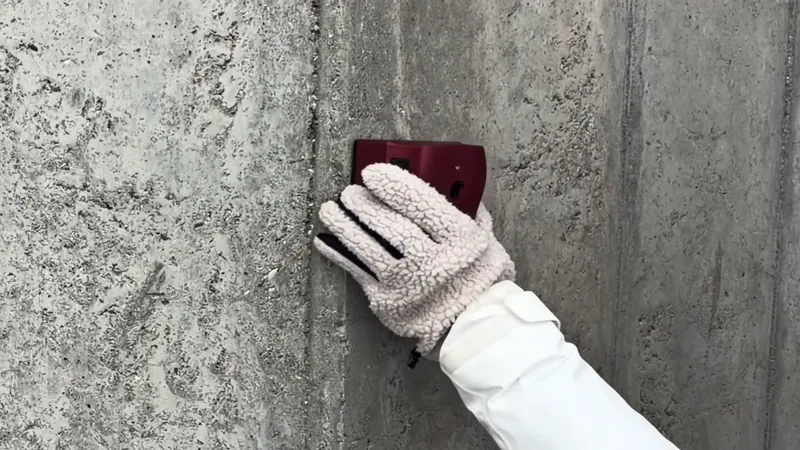
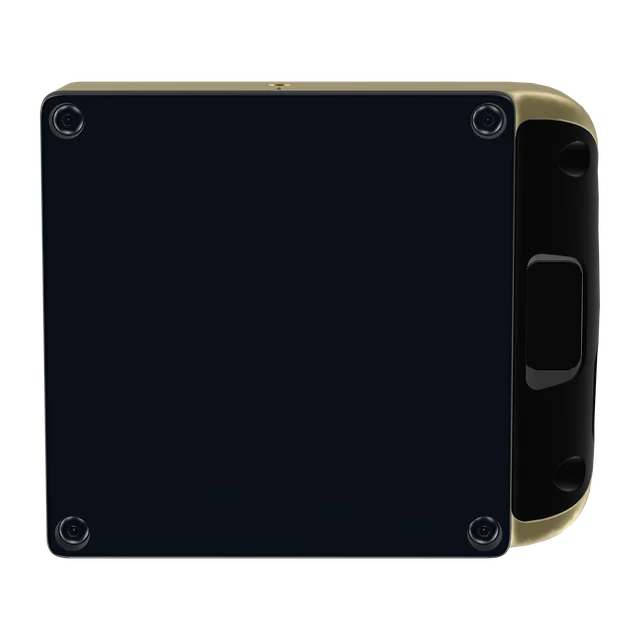
This side goes flat on the surface.
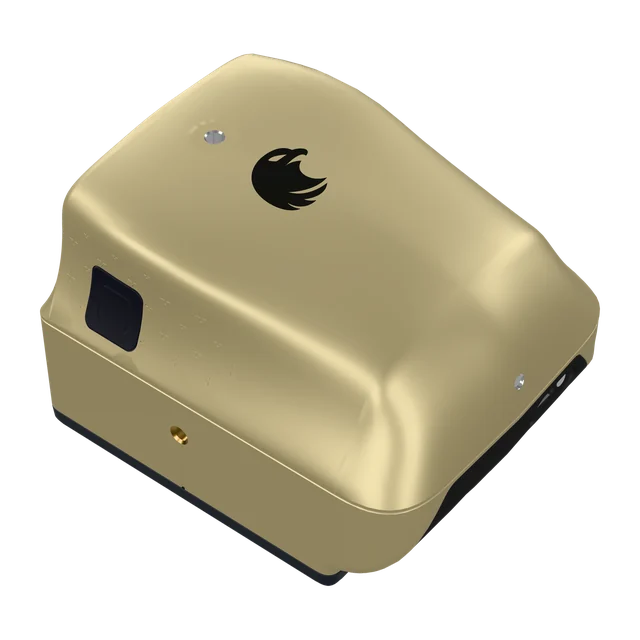
Want to see inside before the next hole?
Eagle XR is a pocket concrete scanner that pairs with your phone and shows rebar, cables, plastic pipes and air voids at their depth. Stated depth in concrete: up to 40 cm. CHF 3,950 excluding VAT, import taxes and delivery.
Buy in Solar GoldPartner link: we may earn a commission. You pay Screening Eagle's normal price.
- Sold and shipped by Screening Eagle
- Same price in all four finishes
- Card, Apple Pay or Google Pay
- Express shipping from Switzerland. US orders ship from Pennsylvania
Sources
- American Concrete Institute, FAQ on minimum cover, ACI 318-19 Table 20.5.1.3.1, www.concrete.org
- ideCAD, ACI 318-19 cover table reproduced in slab detailing help, help.idecad.com
- AECOM Hunt, Quality bulletin: Rebar coverage, aecom.com
- International Residential Code R506.1, as adopted in the 2025 California Residential Code, gocodebook.com
- Structville, Durability and concrete cover to Eurocode 2, structville.com
- Frilo, Durability manual with EN 1992-1-1 Table 4.4N and National Annex values, www.frilo.eu
- Fine software, FIN EC help: reinforcement cover, www.finesoftware.eu
- European Commission JRC, Eurocodes background: durability and cover (Mancini), eurocodes.jrc.ec.europa.eu
- Andrade and Izquierdo, Hormigón y Acero: durability in the new EN 1992-1-1:2023, www.hormigonyacero.com
- Screening Eagle, Eagle XR product page and FAQ, read 3 November 2026, xr.screeningeagle.com